
Imagine buying a digital artwork for thousands of dollars, only to find it’s just a blank square because the server hosting its details went offline. This isn’t a hypothetical nightmare; it’s a reality that has plagued thousands of NFT owners. The core issue? How and where the NFT metadata is stored.
NFT metadata is the invisible DNA of your token. It contains the title, description, attributes (like rarity traits), and the link to the actual image or video file. Without this data, an NFT is just a number on a blockchain with no visual identity. As we move through 2026, the debate over storing this data on-chain versus off-chain has never been more critical. One method promises eternal permanence at a high cost, while the other offers cheap flexibility but carries significant risks of failure.
What Is NFT Metadata and Why Does Location Matter?
To understand the stakes, you first need to know what metadata actually is. When you mint an NFT, you create two distinct things: the token itself (the receipt) and the metadata (the content). The token lives on the blockchain-whether that’s Ethereum, Solana, or Polygon-and is immutable. But the metadata often points elsewhere.
If your metadata is stored centrally on a company’s server, that company controls your asset’s existence. If they go bankrupt, change their terms, or suffer a hack, your NFT’s image can vanish. This happened famously in 2022 when CryptoPunks temporarily displayed blank images due to server migration issues, affecting 12,000 assets. The lesson was clear: if you don’t control the storage, you don’t truly own the asset.
This is why the distinction between on-chain and off-chain storage matters. It determines whether your NFT survives the death of its creator, the shutdown of a platform, or the chaos of a market crash.
The On-Chain Approach: Maximum Security, High Cost
On-chain storage means encoding the metadata directly into the smart contract on the blockchain. Instead of linking to an external URL, the image (usually as an SVG code) and all attributes are written permanently into the block history.
The primary benefit here is absolute immutability. As long as the underlying blockchain exists, your NFT’s data exists. There are no servers to shut down, no companies to sue, and no gateways to break. Projects like Art Blocks have championed this approach since 2020, ensuring 100% of their generative art remains accessible regardless of external factors.
However, there is a steep price tag. Writing data to Ethereum is expensive. Depending on network congestion, storing even a small amount of metadata can cost between $50 and $500 per NFT in gas fees. For a collection of 10,000 items, this adds up quickly. Additionally, Ethereum’s transaction size limits (around 128KB per transaction) restrict how complex your images can be. You can’t easily store high-resolution JPEGs or large video files on-chain without breaking the bank or the block limit.
Despite the costs, high-value art projects increasingly prefer on-chain storage. A 2023 analysis showed that collections with floor prices above 10 ETH were 3.2 times more likely to use on-chain methods than utility-focused projects. For collectors who view NFTs as legacy assets, the premium is worth the guarantee.
The Off-Chain Reality: Cheap, Flexible, but Fragile
Off-chain storage keeps the metadata on external servers or decentralized networks, with the blockchain holding only a link (URI) to that data. This is the most common method today because it is significantly cheaper and faster. Minting an NFT with off-chain metadata might take seconds and cost pennies in gas, compared to minutes and dollars for on-chain options.
There are three main types of off-chain storage, each with different risk profiles:
- Centralized Servers (AWS S3, IPFS Gateways): These are the cheapest and fastest. However, they are single points of failure. If the service provider goes down or deletes your files, your NFT breaks. In 2022, a LooksRare outage affected 47,000 NFTs due to centralized server issues.
- IPFS (InterPlanetary File System): A decentralized protocol that distributes data across many computers. While better than centralized servers, IPFS requires "pinning" to ensure data persists. Many projects rely on single commercial pinning services like Pinata. If Pinata fails or charges too much, unpinned data can disappear. Studies show 20% of Ethereum’s top IPFS projects use Pinata-specific links, creating hidden centralization risks.
- Arweave: A permanent storage solution using a novel consensus mechanism. Users pay once, and the data is theoretically stored forever (with a 200-year retention guarantee). Solana has embraced this heavily, with 90% of its top NFT projects using Arweave for metadata. It offers a strong middle ground: decentralized, permanent, and relatively cheap ($0.015 per MB).
The trade-off is clear. Off-chain solutions offer flexibility-you can update metadata if needed-but they introduce trust dependencies. You are trusting a protocol, a pinning service, or a company to keep your data alive.

Comparing the Options: A Practical Breakdown
Choosing the right method depends on your goals. Are you building a high-end art collection, a gaming item, or a community pass? Here is how the major storage methods stack up against each other.
| Feature | On-Chain (Ethereum) | IPFS (Decentralized) | Arweave (Permanent) | Centralized Server |
|---|---|---|---|---|
| Cost per NFT | $50 - $500+ | $0.10 - $0.50 / month | ~$0.015 / MB (one-time) | Low ($0.023/GB/month) |
| Permanence | High (As long as chain exists) | Medium (Requires pinning) | High (200-year guarantee) | Low (Dependent on company) |
| Censorship Resistance | Very High | High | High | None |
| Update Capability | None (Immutable) | Yes (Mutable pins) | No (Immutable) | Yes |
| Best For | High-value art, collectibles | Budget projects, utilities | Solana NFTs, mid-tier art | Short-term campaigns, games |
Notice the stark contrast in cost and reliability. On-chain is the gold standard for security but prohibitive for mass-market items. Centralized servers are efficient but risky. Arweave and IPFS attempt to bridge the gap, though IPFS still suffers from the "pinning problem" where data can be lost if not actively maintained by third parties.
The Hybrid Solution: Best of Both Worlds?
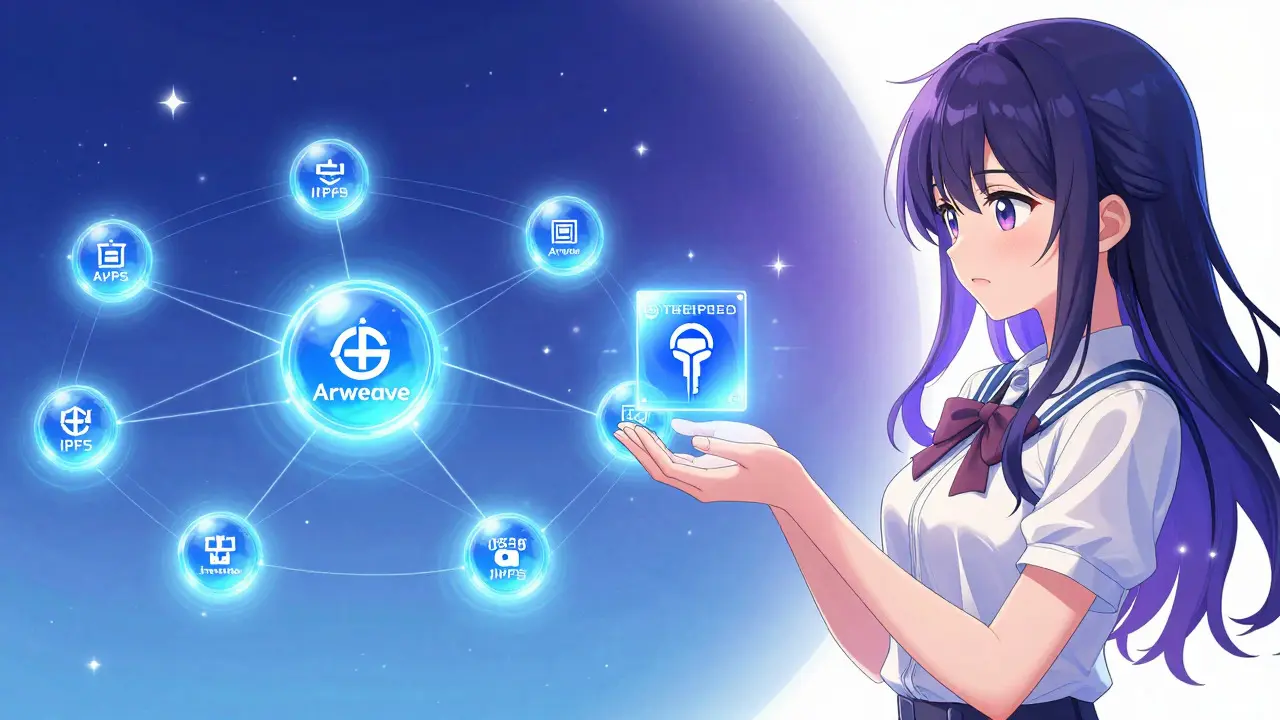
Recognizing the flaws in pure approaches, many developers now adopt a hybrid model. This involves storing the actual media files off-chain (often on IPFS or Arweave) but keeping a cryptographic hash of that metadata on-chain.
Here’s how it works: The smart contract stores a unique fingerprint (hash) of the metadata. Anyone can verify that the off-chain data matches the on-chain hash. If the off-chain data changes, the hash won’t match, alerting users to tampering. This provides 87% of the security benefits of full on-chain storage at only 15% of the cost.
This approach is gaining traction. By late 2023, 22% of Ethereum’s top 100 NFT projects used this hybrid method. It allows for larger file sizes and lower minting costs while maintaining a verifiable link to the original data. For most projects, this is the pragmatic sweet spot.
How to Choose the Right Storage for Your Project
When deciding where to store your NFT metadata, ask yourself these questions:
- What is the expected lifespan of the project? If it’s a short-term marketing campaign, centralized storage might suffice. If it’s a generative art piece meant to last decades, go on-chain or use Arweave.
- What is your budget? Calculate the gas costs for on-chain storage. If minting 10,000 items costs $500,000 in gas, is that sustainable? If not, consider Arweave or a hybrid model.
- Do you need to update metadata? On-chain and Arweave are immutable. If you plan to add new traits or fix errors post-mint, you need a mutable solution like IPFS with a reliable pinning service.
- Which blockchain are you using? Solana users should almost always default to Arweave due to ecosystem standards. Ethereum users have more choices but face higher on-chain costs.
For example, Nike’s .SWOOSH platform uses a hybrid approach, storing hashes on-chain while keeping media on centralized servers for regulatory compliance and speed. Conversely, high-end PFP (Profile Picture) projects often choose full on-chain storage to justify premium floor prices.
Future Trends: What’s Next for NFT Metadata?
The landscape is evolving rapidly. Ethereum’s upcoming upgrades, including EIP-4844 (Proto-Danksharding), promise to reduce data storage costs by up to 90%. This could make on-chain storage economically feasible for a wider range of projects by 2025-2026.
Additionally, the newly formed NFT Metadata Alliance, including giants like Coinbase and OpenSea, aims to establish "hash-on-chain" as the minimum industry standard. Regulatory frameworks like the EU’s MiCA also require metadata immutability for financialized NFTs, pushing enterprises toward more robust storage solutions.
As compression technologies improve and Layer 2 solutions mature, the gap between on-chain and off-chain costs will narrow. However, the fundamental trade-off remains: true ownership requires decentralization, and decentralization currently comes with complexity and cost.
Is on-chain NFT storage really permanent?
Yes, as long as the underlying blockchain continues to exist and is maintained by nodes. On-chain data is replicated across thousands of computers worldwide, making it virtually impossible to delete or alter unless the entire network agrees to a hard fork.
Why do some NFTs show blank images?
This usually happens when the off-chain storage solution fails. If an NFT relies on a centralized server that shuts down, or an IPFS pinning service that loses the data, the link in the smart contract becomes broken, resulting in a blank image.
What is the difference between IPFS and Arweave?
IPFS is a decentralized file system that requires ongoing "pinning" to keep data available, often relying on third-party services. Arweave is a permanent storage protocol where you pay once upfront, and the data is guaranteed to be stored for hundreds of years through its economic model.
Can I change my NFT metadata after minting?
If you use on-chain storage or Arweave, no-the data is immutable. If you use IPFS or a centralized server, yes, you can update the metadata, but this undermines the principle of scarcity and authenticity that NFTs represent.
Which storage method is best for beginners?
For most beginners, a hybrid approach using Arweave for media storage and on-chain hashes is recommended. It balances cost, ease of implementation, and long-term reliability without the extreme gas fees of full on-chain storage.