

If you've been scouring the crypto markets for low-cap assets or looking for ways to cut your trading costs, you might have stumbled across the Mandala Exchange Token is the native utility token of the Mandala Exchange, a centralized trading platform based in the Seychelles. Often identified by its ticker MDX, this coin isn't designed to be a global currency like Bitcoin. Instead, it's a specialized tool built to make trading on its parent platform cheaper and more efficient.
The core purpose of MDX
At its heart, MDX is what's known as a utility token. Think of it like a membership card for a wholesale club; holding the token gives you specific perks that regular users don't get. The primary job of the Mandala Exchange Token is to provide trading fee discounts. For those who actively trade on the platform, these savings can add up quickly. In some cases, token holders can get their fees as low as 0.065%, which is a significant edge when you're making dozens of trades a day.
The token lives within a larger ecosystem managed by the Mandala Exchange, which launched back in December 2020. The platform isn't just for simple buying and selling; it offers a deep toolkit including spot trading, margin trading, and cryptocurrency futures. With over 300 assets and 750 trading pairs, the exchange tries to be a one-stop shop for traders who want variety and liquidity.
Market performance and the volatility reality
Looking at the price history of MDX is a lesson in the extreme nature of the crypto market. To give you an idea of the swing, the token hit an all-time high of $0.553 on April 15, 2021. Since then, it has seen a massive decline, dropping over 99% from that peak. On the flip side, it hit a rock-bottom low of $0.0001999 in early January 2025, only to bounce back by nearly 98.6% recently.
Current data shows the token trading around $0.000397. While the recovery from the all-time low looks impressive on a percentage basis, the actual dollar value remains tiny. This kind of volatility is common for exchange tokens, as their value is heavily tied to how many people are actually using the platform. If the exchange grows, the token becomes more valuable because more people want those fee discounts.
| Attribute | Value |
|---|---|
| Total Supply | 400 Million MDX |
| All-Time High (ATH) | $0.553 (April 2021) |
| All-Time Low (ATL) | $0.0001999 (January 2025) |
| Minimum Fee for Holders | 0.065% |
| Security Rating (CertiK) | 3.6 / 5 |
Understanding the security and liquidity gaps
Before putting money into any low-cap coin, you have to look at the security and liquidity. For MDX, the security is handled via a smart contract that has been reviewed by CertiK, a well-known blockchain security firm. It currently holds a rating of 3.6 out of 5. This is a decent score-it means the contract is generally sound, but it isn't "bulletproof." There's always some level of risk in DeFi and centralized exchange tokens.
The bigger concern for many traders is liquidity. Liquidity is essentially how easy it is to buy or sell a coin without swinging the price wildly. Recent data shows very low 24-hour trading volumes for MDX. When volume is zero or near-zero, it means there aren't many buyers and sellers active. This can make it difficult to exit a position quickly if you decide to sell.
Because of this, you won't find MDX on every major exchange. While you can find information on how to buy it via credit cards or Web3 wallets on platforms like Binance, it isn't yet fully integrated into the trading pairs of giants like Crypto.com. You'll likely need to use the Mandala Exchange itself or a decentralized exchange (DEX) to acquire it.
Crucial Warning: MDX vs. MDEX
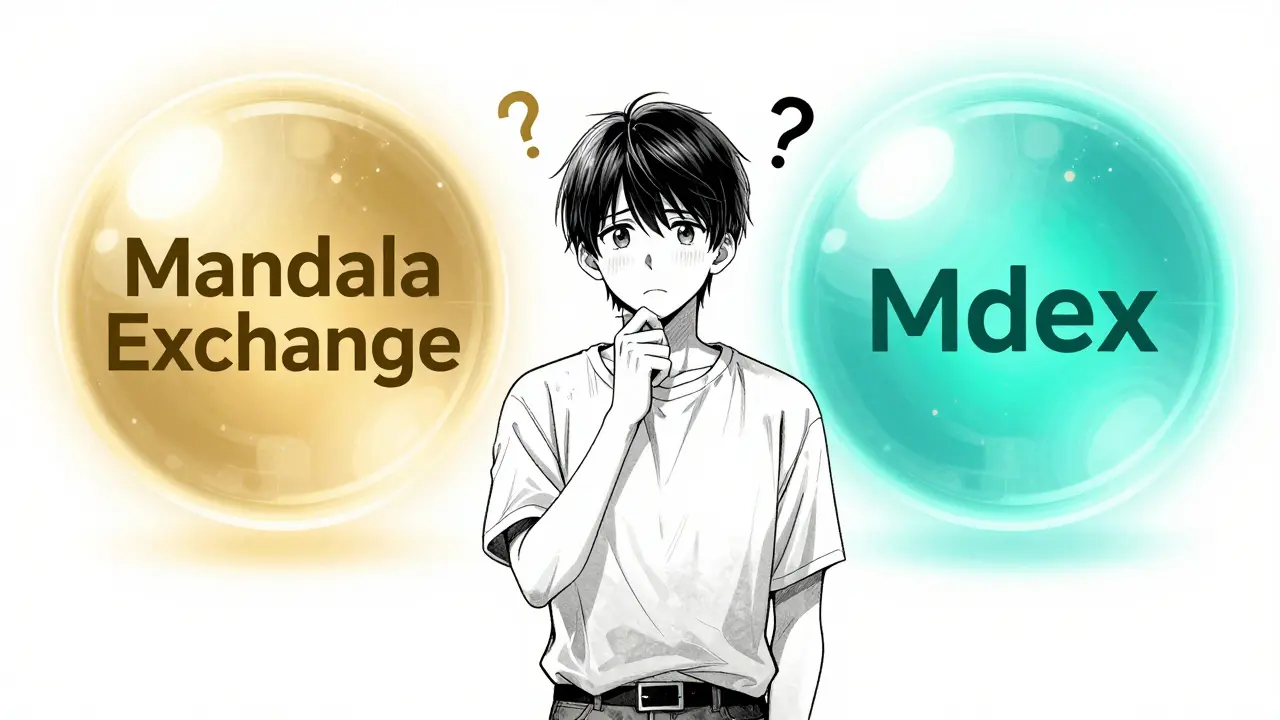
Here is where things get confusing, and where many beginners make a costly mistake. There is another project called Mdex that also uses the ticker MDX. These are not the same thing.
- Mandala Exchange Token: A centralized exchange utility token focused on trading fee reductions.
- Mdex: A decentralized exchange (DEX) based on the Heco blockchain (Huobi Eco-Chain) with a much larger total supply of 1 billion tokens.
If you're looking at a chart and seeing a different price or supply than what we've discussed, you're probably looking at the Mdex project instead of the Mandala token. Always double-check the contract address and the project's official website before hitting the buy button.
Is MDX right for you?
Whether this coin is a good move depends entirely on how you plan to use it. If you are a high-volume trader who spends a lot of time on the Mandala Exchange, holding MDX is a no-brainer because it directly lowers your operating costs. You're essentially paying for a subscription to cheaper trading.
However, if you're looking at it purely as a speculative investment, the risks are high. The token has a history of extreme crashes, and the current lack of trading volume suggests that market interest has cooled off. The long-term survival of the token depends on whether the Mandala Exchange can attract more users and increase its daily trading activity.
What does the MDX token actually do?
The MDX token serves as a utility token for the Mandala Exchange. Its main function is to give holders a discount on trading fees. Instead of paying standard rates, holders can access fees as low as 0.065% when trading assets on the platform.
Is Mandala Exchange Token safe?
The token's smart contract has been audited by CertiK and received a security score of 3.6 out of 5. While this indicates a moderate level of security, all cryptocurrency investments carry inherent risks, especially with lower-liquidity assets.
Where can I buy MDX?
The most reliable place to acquire MDX is through the Mandala Exchange itself. Some users also use Web3 wallets or decentralized exchanges (DEXs) to trade the token, as it is not available on all major centralized exchanges like Crypto.com.
What is the difference between Mandala Exchange and Mdex?
They are completely different projects. Mandala Exchange is a centralized platform based in the Seychelles. Mdex is a decentralized exchange (DEX) operating on the Heco blockchain. They happen to share the same ticker (MDX), but they have different teams, different supplies, and different goals.
Why did the price of MDX drop so much since 2021?
Like many tokens launched during the 2021 bull run, MDX experienced a massive spike in speculative interest that wasn't sustainable. As the general crypto market entered a bear phase and platform adoption fluctuated, the price corrected downward significantly.
Next Steps and Troubleshooting
If you've decided to get into MDX, start by creating an account on the Mandala Exchange. Verify your identity to unlock full trading features, including futures and margin trading. If you find that you cannot trade MDX on your preferred app, check if you are using a compatible Web3 wallet that supports the token's specific blockchain.
For those who already hold the token and are seeing "zero volume" on tracking sites, don't panic-this often happens when data aggregators lose a connection to a specific exchange's API. The best way to verify actual liquidity is to check the order books directly on the Mandala Exchange trading interface.
Aaron Zeiler
most people miss the biggest point here which is the liquidity risk
if you can't exit a position because the order book is thin the theoretical fee discount doesn't actually mean anything since you're basically trapped in the asset
Bevon Findley
Quite a quaint little project :)
Rachel S
It is absolutely catastrophic to confuse MDX with MDEX! 😱 One is a centralized utility and the other is a DEX on Heco; the financial implications of such a mix-up are truly harrowing for a novice investor! ✨
Ipsita Seal
too much reading for a coin that dropped 99%
its me
We must ask ourselves if the pursuit of a 0.065% fee discount isn't just a symptom of a deeper spiritual void in the modern trader's soul, sacrificing stability for the illusion of efficiency
Carli Bates
imagine buying a token for the fees while the price drops 99 percent lol truly a masterclass in financial planning
Gabrielle Danis
The distinction regarding the ticker overlap is critical. Many traders overlook the specific contract addresses, which leads to significant capital loss. Always verify the source via a block explorer before executing a trade.
Sri Astuti
I find it utterly repulsive that people are still talking about this as a viable asset when the volume is practically non-existent, and honestly, the CertiK score is just a participation trophy in the world of security because a 3.6 is barely acceptable for anyone who actually values their capital 🙄 it's just another pump and dump waiting for a miracle that will never happen because the utility is fundamentally flawed and the market has already decided this project is a ghost town 🙄
Rushell Perry
just remember to double check those addresses everyone keep it simple and stay safe out there
Abhishek Verma
Wow, a guide on a coin that basically doesn't exist anymore. Super helpful for those who love holding bags of dust
Elle Kharitou
It is so important to approach these low-cap assets with a heart full of patience and a mind open to the lessons they teach us about volatility 🌟 In the grand tapestry of the blockchain, every dip is just a breath before a possible rise, and while the numbers look scary, the journey of learning how to navigate these waters is where the true value lies for any global citizen of the crypto space 🌏✨💖
edie rosa
The lack of volume is a moral failing of the project's leadership. They promised an ecosystem and delivered a void. Speculating on this is just gambling for people who lack the discipline to trade real assets.
Michael Repak
I completely agree with the points made about liquidity!!! It is so vital for new traders to understand this, and I'm glad this was highlighted!!!
Iestyn Lloyd
A sensible overview. The utility is clear, though the market appetite seems limited at present.
April D Thompson
Oh honey, we are all just dancing on the edge of a digital volcano! 🌋 If you want to ride the wave of a low-cap coin, just embrace the chaos and remember that the only real way to lose is to stop learning from the madness!