

Loopring (LRC) isn’t just another crypto coin. It’s a Layer 2 scaling protocol built on Ethereum that lets people trade cryptocurrencies faster and cheaper - without giving up security. If you’ve ever waited minutes for a trade to confirm on Uniswap or paid $50 in gas fees just to swap tokens, Loopring offers a real alternative. It doesn’t replace Ethereum. It works with it. And that’s why it matters.
How Loopring Actually Works
Loopring runs on top of Ethereum. That means it doesn’t create its own blockchain. Instead, it takes hundreds of trades, bundles them up, and processes them off-chain using a technology called zero-knowledge rollups (zkRollups). Think of it like a private room where trades happen instantly. Once everything is settled, Loopring sends one single proof back to Ethereum to confirm all those trades at once. This cuts costs and speeds things up dramatically.
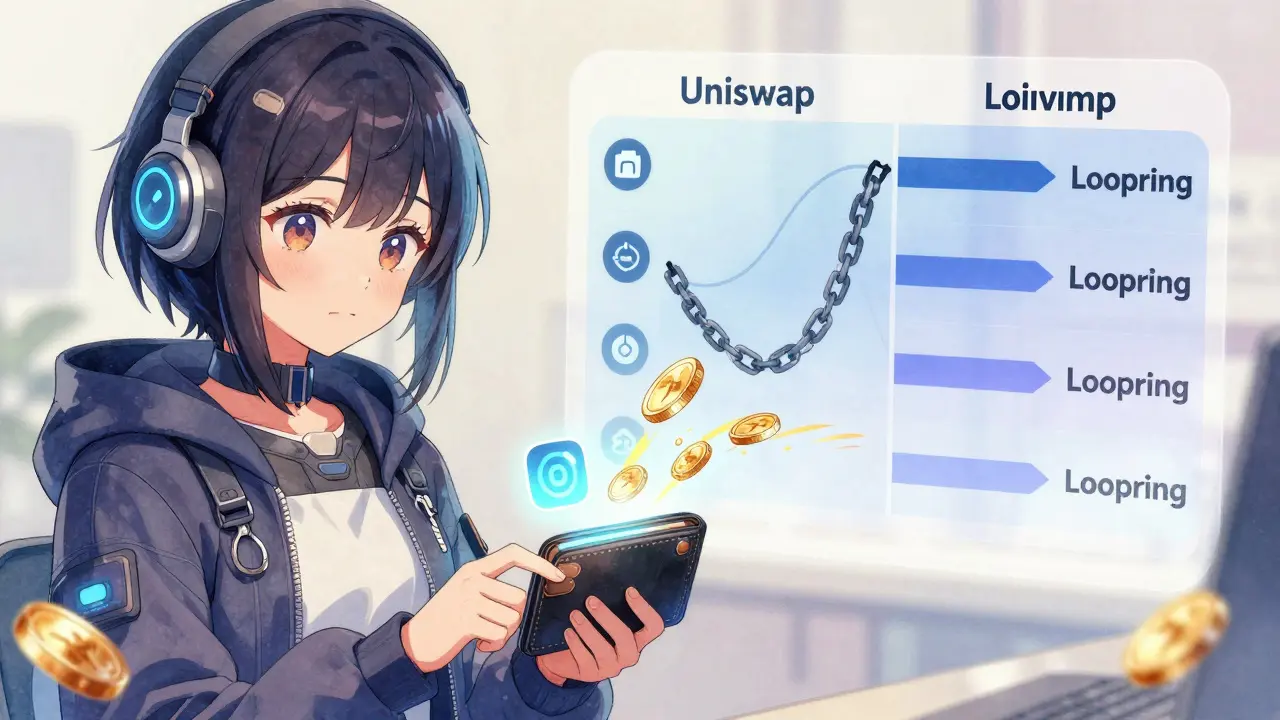
On regular Ethereum DEXs like Uniswap, every trade needs its own transaction. That’s slow and expensive. Loopring does 100 trades in one Ethereum transaction. The result? Trades settle in under a second. Fees drop to pennies. And because Ethereum still validates everything, your funds stay as secure as if you were trading directly on the main chain.
The LRC Token’s Role
LRC is the fuel for this system. You can’t use ETH or USDT to pay fees on the Loopring DEX - you need LRC. Every time someone trades, 80% of the fee goes straight to liquidity providers. That’s the people who put up coins so others can trade. The other 20% is split between insurance funds and the Loopring DAO - a community-run organization that decides how the protocol evolves.
There are 1.375 billion LRC tokens total. Around 1.33 billion are already in circulation. That’s a lot. But unlike some coins that keep minting new tokens, Loopring’s supply is fixed. No inflation. That’s one reason some investors see it as a store of value tied to usage - not speculation.
Why Loopring Got Attention
In late 2021, LRC’s price jumped from $0.38 to $3.70 in two weeks. Why? Rumors said GameStop - yes, the video game store - was using Loopring to build its own NFT marketplace. It turned out to be true. GameStop launched its NFT platform using Loopring’s tech. That sent traders into a frenzy.
But here’s the catch: that hype didn’t stick. By September 2022, LRC had dropped to 30 cents. The price didn’t stay up because the market crashed. But the partnership still matters. GameStop didn’t pick a random protocol. They chose Loopring because it handles high-volume trading smoothly. If more big brands follow, LRC could become more than just a fee token - it could become infrastructure.
Loopring vs Other DEXs
Here’s how Loopring stacks up against other decentralized exchanges:
| Feature | Loopring | Uniswap v3 | Curve |
|---|---|---|---|
| Speed | Under 1 second | 1-5 minutes | 1-3 minutes |
| Gas Fee (per trade) | $0.01-$0.05 | $5-$50 | $3-$20 |
| Token Used for Fees | LRC | ETH | ETH or stablecoins |
| Security Layer | Ethereum (zkRollup) | Ethereum (on-chain) | Ethereum (on-chain) |
| Best For | High-frequency trading, low fees | General swaps, liquidity provision | Stablecoin swaps |
Loopring wins on speed and cost. But it’s not for everyone. If you’re just swapping ETH for USDC once a month, the extra step of bridging to Loopring might feel like overkill. But if you’re trading often - say, day trading altcoins - the savings add up fast.
Who Uses Loopring?
It’s not just big companies. Retail traders are using it too. People in places like the Philippines, Nigeria, and Brazil - where internet costs are high and banking is unreliable - use Loopring to trade without paying bank fees or waiting hours. The interface is simple: connect your wallet, deposit funds, and trade. No KYC. No middleman. Just crypto-to-crypto.
Some users complain it’s too technical at first. Bridging from Ethereum mainnet to Loopring’s Layer 2 takes a few minutes, and you need to understand gas fees, approvals, and wallet security. But once you get past that, it’s smoother than most centralized exchanges. And you never lose control of your keys.
What’s Next for Loopring?
Loopring’s future depends on two things: Ethereum’s growth and adoption by more platforms. If Ethereum becomes too expensive again, Layer 2s like Loopring will be essential. If Ethereum solves scaling on its own, Loopring still has value - it’s already proven it can handle thousands of trades per second.
Analysts predict LRC could trade between $0.62 and $0.74 by 2030. Those numbers aren’t guarantees. Crypto moves fast. But what’s clear is that Loopring isn’t chasing hype. It’s solving a real problem: making decentralized trading usable at scale.
It’s not the flashiest project. No celebrity endorsements. No meme coins. Just clean code, strong cryptography, and a focus on performance. That’s why it’s still around when so many others faded.
Getting Started with Loopring
If you want to try it:
- Get an Ethereum wallet like MetaMask or Rainbow.
- Buy some ETH and LRC (you’ll need both).
- Go to loopring.org and connect your wallet.
- Use the bridge to move funds from Ethereum to Loopring’s Layer 2.
- Start trading. Fees will be a fraction of what you’d pay elsewhere.
There’s no rush. Test with small amounts first. The learning curve is real, but once you get used to it, you’ll wonder why you ever used anything else.
Is Loopring safe to use?
Yes. Loopring is non-custodial, meaning you always control your own funds. All trades are settled on Ethereum, so the security of the main chain protects your transactions. It doesn’t hold your crypto - your wallet does. The only risk is user error, like sending funds to the wrong address or losing your private key.
Do I need to hold LRC to trade on Loopring?
Yes. You must pay trading fees in LRC. You can’t use ETH or USDT for fees. But you can buy LRC on most major exchanges like Binance or Kraken and then transfer it to your wallet. Once you have it, you can use it to trade anything else on the Loopring DEX.
Why is Loopring’s price so volatile?
LRC’s price moves with crypto market sentiment, news, and adoption. Its biggest spike came from the GameStop rumor, and its drop followed the 2022 bear market. Since it’s not a major coin by market cap, small amounts of buying or selling can swing the price. Long-term value depends on how many people use the protocol, not just speculation.
Can I earn interest on LRC?
Not directly. Loopring doesn’t offer staking or yield farming. But if you provide liquidity on the Loopring DEX - meaning you deposit tokens to help others trade - you earn 80% of the trading fees paid in LRC. That’s how most users earn from the protocol.
Is Loopring better than Arbitrum or Optimism?
It depends. Arbitrum and Optimism are general-purpose Layer 2s - they run apps like DeFi protocols, NFT marketplaces, and games. Loopring is specialized: it’s built for trading. If you want fast, cheap swaps, Loopring wins. If you want to lend, borrow, or play games on Layer 2, Arbitrum or Optimism are better choices. They’re not competitors - they serve different needs.
Loopring doesn’t try to be everything. It’s laser-focused on one thing: making decentralized trading fast, cheap, and secure. And for people who trade often, that’s more valuable than any price prediction.
yogesh negi
Loopring is one of those projects that quietly does the heavy lifting while everyone chases memecoins. The zkRollup tech alone makes it a game changer for retail traders who can't afford $50 gas fees just to swap ETH for USDC. And the fact that LRC fees go straight to liquidity providers? That's sustainable incentive design right there. No need for endless tokenomics gimmicks when the model works.
Sarah Shergold
LRC is just another useless token. Why do we need another layer 2 when Arbitrum already works?
Kyle Tully
You're missing the point entirely. Loopring isn't trying to compete with Arbitrum. It's optimized for one thing: high-frequency trading with near-zero fees. Most Layer 2s are bloated general-purpose chains. Loopring is surgical. It's not for your weekend swap. It's for the people who trade 20 times a day and care about slippage and cost efficiency. If you don't get that, you're not the target audience.
Scott McCrossan
Funny how everyone acts like Loopring invented zkRollups. It's just another zkEVM clone. The real innovation was Optimism's optimistic rollups. This is just rehashing old tech with a new coat of paint and a fancy whitepaper.
Nicole Stewart
LRC price went to $3.70 once. Now it's back to 30 cents. That's the whole story.
george chehwane
The real irony is that Loopring's entire value proposition relies on Ethereum being expensive. If Ethereum ever gets cheap enough to handle high throughput natively, Loopring becomes redundant. It's not a solution-it's a temporary band-aid for a problem Ethereum might solve itself. That's not innovation. That's opportunism.
sruthi magesh
India's retail traders are using this? Please. Most of them don't even know what a private key is. They just buy LRC hoping it'll moon. This isn't adoption. It's gambling with extra steps.
Nova Meristiana
LRC isn't even top 50 by market cap. How is this supposed to be infrastructure? It's a niche tool for a tiny slice of the crypto population. If you're excited about this, you're either delusional or being paid to shill.
Alex Williams
Let me break this down simple: if you're trading altcoins more than once a week, Loopring saves you hundreds of dollars a month in gas. The bridge setup is a one-time hassle. After that, it's smoother than Binance. And yes, you need LRC for fees-but that's a feature, not a bug. It aligns incentives. The more you trade, the more value accrues to the token. It's not speculation. It's utility.
Chris Thomas
You're all missing the macro angle. Loopring's real power isn't in trading fees. It's in its ability to handle thousands of TPS without compromising decentralization. That's the holy grail. Most Layer 2s rely on centralized sequencers. Loopring doesn't. That's why GameStop picked it. Not because it's trendy. Because it's bulletproof.
Lisa Parker
I tried it once. The bridge took forever and I thought I lost my money. Never again. Too much friction for something that should be simple.
kieron reid
The fact that this post has 1000+ upvotes proves how little people understand Layer 2s. Loopring is technically impressive. But nobody uses it. The daily active users are in the low thousands. You can't build infrastructure on a ghost town.
JJ White
This is the most dangerous narrative in crypto right now. People think 'secure because it's on Ethereum' means safe. Wrong. You're still trusting a frontend. You're still trusting a bridge. You're still trusting a team that could vanish tomorrow. Loopring doesn't make crypto safe. It just makes it cheaper to lose your money.
Rajib Hossaim
While I appreciate the technical breakdown, I must emphasize that the real value of Loopring lies not in its speed or fee structure, but in its commitment to non-custodial integrity. In a world where centralized exchanges dominate, this is a rare beacon of true decentralization. It may not be flashy, but it is foundational.
Ian Plunkett
LRC is a dead coin. GameStop's partnership was a one-time PR stunt. The protocol has no real traction. The charts prove it. Stop pretending this is the future. It's a relic.
Geet Kulkarni
OMG I love this so much 🤩 I've been using Loopring for 6 months now and my gas fees are literally 1% of what I used to pay on Uniswap. The UI is kinda clunky at first but once you get used to it? Pure magic. Also, LRC is undervalued-this is the real DeFi infrastructure. 💎✨
Charrie VanVleet
If you're new to Layer 2s, don't be intimidated. Start with a $5 swap. Use the official Loopring app. Watch how fast it goes. Feel how little you pay. Then come back and tell me it's not worth it. This isn't hype. It's physics. Better tech beats slower, pricier tech. Always.
Alan Enfield
I used to think Loopring was niche. Then I saw a Nigerian trader do 15 swaps in 2 minutes for under $0.10 total. That's not crypto. That's financial liberation. This isn't about price targets. It's about access.
Ruby Ababio-Fernandez
LRC is garbage. Why would anyone hold a token that only pays fees? It's not a store of value. It's a utility token with zero scarcity. The supply is fixed? Big deal. No demand = no value.
James Breithaupt
I live in the US. My cousin in Brazil uses Loopring daily. He sends remittances as USDC swaps. No bank. No fee. No delay. That’s the real story. This isn’t about trading. It’s about people bypassing broken systems. That’s why it matters.