
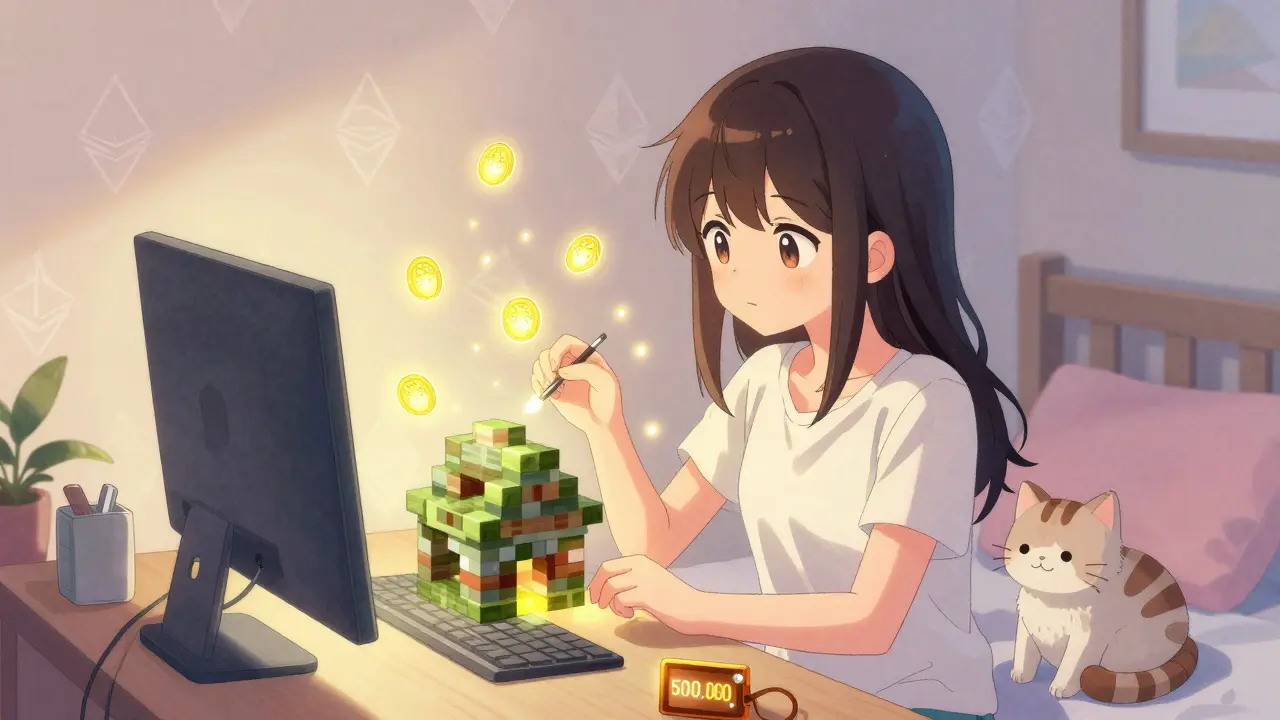
BEBE is a cryptocurrency token built on the Ethereum blockchain that aims to connect traditional video games with blockchain rewards. Launched in March 2024, it’s not another meme coin pretending to be useful - it’s trying to solve a real problem: how do you let people who play Grand Theft Auto V, Minecraft, or Rust earn crypto without forcing them to learn wallets, gas fees, or NFTs first?
How BEBE Works: Private Servers, Not New Games
Most blockchain games ask you to start from scratch. You download a new title, learn its rules, buy digital land, and hope it doesn’t vanish in six months. BEBE does something different. It lets you play the games you already love - but on private, modified servers powered by its network.
Here’s how it works: You join a BEBE-powered server for Minecraft or Rust. You play normally. Kill zombies, build houses, trade items. But now, every action - like winning a match or completing a quest - earns you BEBE tokens. No extra steps. No complicated interface. Just your game, with crypto rewards tacked on.
This model is called chain game mode. It uses API-based wallet integration so your MetaMask or Trust Wallet automatically tracks your earnings. The system runs on a decentralized infrastructure called DePIN (Decentralized Physical Infrastructure Networks), meaning servers are hosted across a network of contributors, not one company’s data center.
Tokenomics: 500 Billion Tokens and the Inflation Problem
BEBE has a total supply of 500 billion tokens. That’s not a typo. Most cryptocurrencies cap supply at millions or billions. BEBE’s supply is half a trillion.
Why? Because the project assumes most tokens will be earned by players over time. But here’s the catch: with a current price around $0.00005425, each token is worth less than a penny. And with 500 billion in circulation, the total market cap sits at roughly $8.25 million - tiny compared to giants like Gala ($1.2 billion) or Immutable ($2.3 billion).
This massive supply creates serious inflation pressure. If 10,000 players each earn 1 million BEBE per month, that’s 10 billion tokens added to circulation every 30 days. Without a strong burn mechanism or demand driver, the value per token keeps getting diluted. Experts call it a "tokenomics flaw" - the math doesn’t balance unless adoption explodes.
Price, Volume, and Volatility: A Rollercoaster
BEBE hit its all-time high of $0.000776 in September 2024. Since then, it’s dropped over 90%. As of March 2026, it trades around $0.00005425. The 24-hour trading volume hovers between $400,000 and $500,000 - low for any crypto, let alone one trying to serve gamers.
Most trading happens on decentralized exchanges like PancakeSwap. You won’t find BEBE on Binance, Coinbase, or Kraken. That means liquidity is thin. A single large buy or sell can swing the price 10% in minutes. Analysts warn this makes BEBE vulnerable to manipulation - a common trait in micro-cap tokens.
On-chain data shows a 19.49% price volatility over 14 days. That’s higher than 90% of other tokens. The RSI sits near 56 - neutral, but not stable. The Fear & Greed Index shows "Greed" (71), meaning retail investors are buying aggressively despite weak fundamentals. That’s a red flag.

Real-World Use: What Players Actually Experience
Let’s talk about what happens when you try to use BEBE.
On the positive side: Some users report earning $20-$40 per month just by playing Rust or Minecraft on BEBE servers. One Reddit user said they earned $28 in three months with "minimal setup." That’s real money for a side hustle.
But the negatives are brutal. To withdraw your BEBE, you need to send it from the server to your wallet. That costs Ethereum gas fees - typically $1.20 per transaction. At BEBE’s current price, $1.20 in gas fees equals over 22,000 BEBE tokens. If you only have 500,000 BEBE ($27), you’re paying over 50% of your balance just to cash out.
Users on Telegram and Trustpilot complain constantly: "I earned $30 but paid $18 in fees." "I tried to withdraw and my transaction failed three times." "Customer support took 72 hours to reply."
Trustpilot gives BEBE a 2.3/5 rating from 87 reviews. The most common complaints? High fees, slow support, and confusing withdrawal steps. The platform’s own documentation is 47 pages long. For someone who just wants to play Minecraft, that’s a wall.
Who Is BEBE For? (And Who Should Avoid It)
BEBE isn’t for everyone. It’s designed for:
- Players who already play GTA V, Minecraft, or Rust and want to earn crypto without switching games.
- People with basic crypto knowledge - who understand wallets, gas fees, and Ethereum.
- Those willing to accept high risk for a chance at long-term upside.
It’s NOT for:
- People looking for stable returns - BEBE is too volatile.
- Those with small balances - gas fees eat up tiny earnings.
- Non-technical users - setup is not beginner-friendly.
- Investors seeking blue-chip assets - BEBE has no major exchange listing or institutional backing.
The Bigger Picture: GameFi’s Future and BEBE’s Place
The GameFi market hit $8.4 billion in 2025. Over 50 million people play blockchain games. But 95% of them use platforms like Gala or Immutable - projects that built their own games from scratch.
BEBE’s innovation is simple: don’t make a new game. Make the old ones earn crypto. That’s smart. If it works, it could be the gateway that brings millions of Web2 gamers into Web3.
But right now, it’s stuck. The tokenomics don’t support the model. Gas fees kill small transactions. Liquidity is too low. No major exchanges list it. No big studios partner with it. The roadmap promises mobile apps and Binance Smart Chain support by Q1 2026 - that could fix the fee problem. But until then, it’s a high-risk bet.
Analysts at Delphi Digital give BEBE only a 35% chance of surviving two years. Others say if user growth hits 100,000 active players by late 2026, it could 5x or 10x. That’s a big "if."
Final Verdict: A Glimmer of Potential, Buried Under Problems
BEBE isn’t a scam. It’s not a Ponzi. It has a working product, real players, and a clever idea: bring blockchain rewards to games people already love.
But the execution is broken. The token supply is too large. The fees are too high. The liquidity is too thin. The support is too slow. And until those things change, BEBE remains a niche experiment - not a revolution.
If you’re a player who enjoys Minecraft on private servers and you’re okay with losing money on gas fees for the chance of future gains? Try it. Play for fun. Don’t invest.
If you’re looking to make money? Walk away. There are better, safer ways.
What is BEBE crypto used for?
BEBE crypto is used as a reward token in private game servers for popular titles like Minecraft, Rust, and Grand Theft Auto V. Players earn BEBE tokens by completing in-game tasks, which they can then withdraw to their crypto wallets. It’s designed to bridge Web2 gaming with blockchain rewards without requiring players to learn new games.
Can I buy BEBE on Coinbase or Binance?
No, BEBE is not listed on any major centralized exchanges like Coinbase, Binance, or Kraken. It’s only available on decentralized exchanges (DEXs) such as PancakeSwap. This limits liquidity and makes buying and selling harder and more expensive.
Why is BEBE’s price so low?
BEBE’s price is low because of its massive 500 billion token supply. With so many tokens in circulation and limited demand, each individual token is worth very little - around $0.00005425 as of March 2026. The tokenomics don’t match the economic reality of transaction costs, leading to inflationary pressure and low perceived value.
Is BEBE a good investment?
BEBE is not a good investment for most people. It’s a high-risk, micro-cap token with low liquidity, high volatility, and serious flaws in its tokenomics. While it has a unique use case, the risks far outweigh the potential rewards. Only experienced crypto users who understand the risks should consider holding BEBE - and even then, only as a speculative bet, not a core holding.
How do I withdraw BEBE tokens?
To withdraw BEBE, you must send it from the game server to your Ethereum wallet (like MetaMask). This requires paying Ethereum gas fees - typically $1.20 per transaction. At BEBE’s current price, this fee can cost more than 20% of your total balance, making small withdrawals economically unviable. Always check your balance against gas costs before attempting a withdrawal.
Does BEBE have a mobile app?
As of March 2026, BEBE does not have a mobile app. The project has announced plans to release one in Q1 2026, which could improve accessibility for mobile gamers. Until then, access is limited to desktop platforms through private servers and wallet integration.
What are the biggest risks of using BEBE?
The biggest risks are: high Ethereum gas fees that make small withdrawals unprofitable, extremely low liquidity making price manipulation easy, lack of exchange listings, poor customer support, and a token supply that’s too large to sustain value. Regulatory scrutiny from agencies like the SEC is also a looming threat due to its reward-based model.
Is BEBE safe to use?
Technically, BEBE’s smart contracts are audited and run on Ethereum, which is secure. But safety isn’t just about code - it’s about usability and sustainability. The platform has poor user support, high fees, and a shaky economic model. Many users report losing money on gas fees or being unable to withdraw. Use it at your own risk.
For now, BEBE remains a fascinating experiment - not a solution. It shows how hard it is to merge Web2 and Web3. The idea is smart. The execution? Still a work in progress.
Sahithi Reddy
Just play and earn bro no stress 🤙 Minecraft on BEBE servers is actually chill now
Tobias Wriedt
This is literally the future of gaming 🎮💸 I’ve made $32 this month just farming zombies in Rust. No cap. Why are people still complaining about gas fees? You’re not paying $1.20 to buy a pizza. You’re paying to unlock real value. Grow up.
Zachary N
Let’s break this down properly. The core idea of BEBE - attaching crypto rewards to existing Web2 games - is brilliant. It bypasses the biggest barrier in GameFi: onboarding. Most people won’t download a new game with a 47-page manual. But they’ll keep playing Minecraft. The problem isn’t the concept. It’s the execution. Gas fees on Ethereum are a dealbreaker for micro-rewards. A 500B supply without a deflationary mechanism is just inflation on steroids. And no exchange listings? That’s not niche, that’s suicide. The solution isn’t more hype. It’s moving to BSC, capping daily earnings, and implementing batch withdrawals. Until then, it’s a cool demo with a death sentence.
Katrina Smith
lol so you mean to tell me i gotta pay more to cash out than i earned? genius move. next they'll charge me to breathe
Billy Karna
I’ve been running a BEBE Minecraft server for 6 months. We have 2k active players. The community is tight-knit. People are genuinely earning side income. But you’re right - gas fees are brutal. We’ve started pooling withdrawals: if you have under 1M BEBE, just hold. Wait till you hit 5M. Then one transaction. Also, the devs are testing a BSC bridge. It’s coming. Don’t write it off yet. This has legs. It’s just in diapers.
Lucy de Gruchy
Let’s be real - this is just another pump-and-dump disguised as innovation. 500 billion tokens? That’s not a tokenomics model. That’s a Ponzi math problem. And ‘chain game mode’? That’s not a tech breakthrough - it’s a hack. They’re piggybacking on Minecraft’s userbase while pretending to be revolutionary. The SEC is going to shut this down within 18 months. Mark my words. And don’t even get me started on the Telegram support bots. They’re worse than Windows Update.
Lauren J. Walter
I earned $28 in 3 months. Then I tried to withdraw. Gas fee was $1.40. My balance was $27.80. I cried. Not because I lost money. Because I believed. And now I’m just… numb.
Carol Lueneburg
I know it’s rough but don’t give up 💛 I’ve seen people go from $0 to $200/month just by playing Rust 2 hours a day. It’s not easy but it’s real. And the devs listen on Discord. They’re not ignoring us. We just have to be patient and keep feeding the ecosystem. One day this will be the gateway for millions. I believe in it. 🙏✨
Brenda White
so u mean to tell me i gotta have a wallet and know what gas is to play minecraft? who designed this? a crypto bro who thinks everyone is him? this is so f***ing backwards
Ernestine La Baronne Orange
I’ve been on this ride since day one. I lost $180 in gas fees trying to cash out $150 worth of BEBE. I’ve sent 17 support tickets. Only 3 got replies. One said ‘check the FAQ’. The FAQ is 47 pages long. I read all of it. It didn’t help. I’m not mad. I’m just… disappointed. This could’ve been beautiful. Instead, it’s a graveyard of broken dreams and Ethereum transaction receipts. I still play. But I don’t believe anymore.
Manali Sovani
The notion that this project is ‘bridging Web2 and Web3’ is laughable. Web2 users do not want tokens. They want fun. They want to build castles. Not to calculate APY while mining cobblestone. This is a solution in search of a problem. The tokenomics are a mathematical absurdity. The UX is hostile. The community is toxic. And the leadership? Silent. This is not innovation. It is arrogance wrapped in blockchain jargon.
Konakuze Christopher
They’re not building a game. They’re building a pyramid. 500B tokens. Zero listings. High fees. Slow support. This isn’t a project. It’s a trap. And you’re all falling for it. Wake up.
sai nikhil
I play BEBE servers with my brother in India. We earn enough for data packs and snacks. Gas fees are a pain but we wait. We pool. We don’t withdraw daily. It’s not perfect. But it’s ours. And we’re happy. That’s what matters.
George Hutchings
I’m from the US. My cousin in Nigeria plays BEBE on his phone. He says it’s the only way he can earn crypto without a bank account. That’s powerful. Yeah, the fees suck. But for someone with zero access? This is a lifeline. Maybe the tech is messy. But the impact? Real.
Henrique Lyma
The fact that you’re even considering this as a legitimate innovation says more about you than BEBE. 500 billion tokens. A 90% drop. No exchange listing. The only thing this project is bridging is your wallet and the dumpster. Move on.
Steph Andrews
I don’t care if it’s messy. I don’t care if the fees are high. I care that I can play my favorite game and actually get something back. That’s more than most crypto projects offer. I’ve seen people quit gaming because it felt pointless. BEBE gave them a reason to log in. That’s worth something. Even if it’s just $5 a month. Even if it’s just one person. It matters.
Prakash Patel
You all are missing the point. BEBE isn’t about the token. It’s about the servers. The community. The fact that someone built something real for players who didn’t ask for blockchain. The token is just the byproduct. If you focus on the price, you’re already lost.