
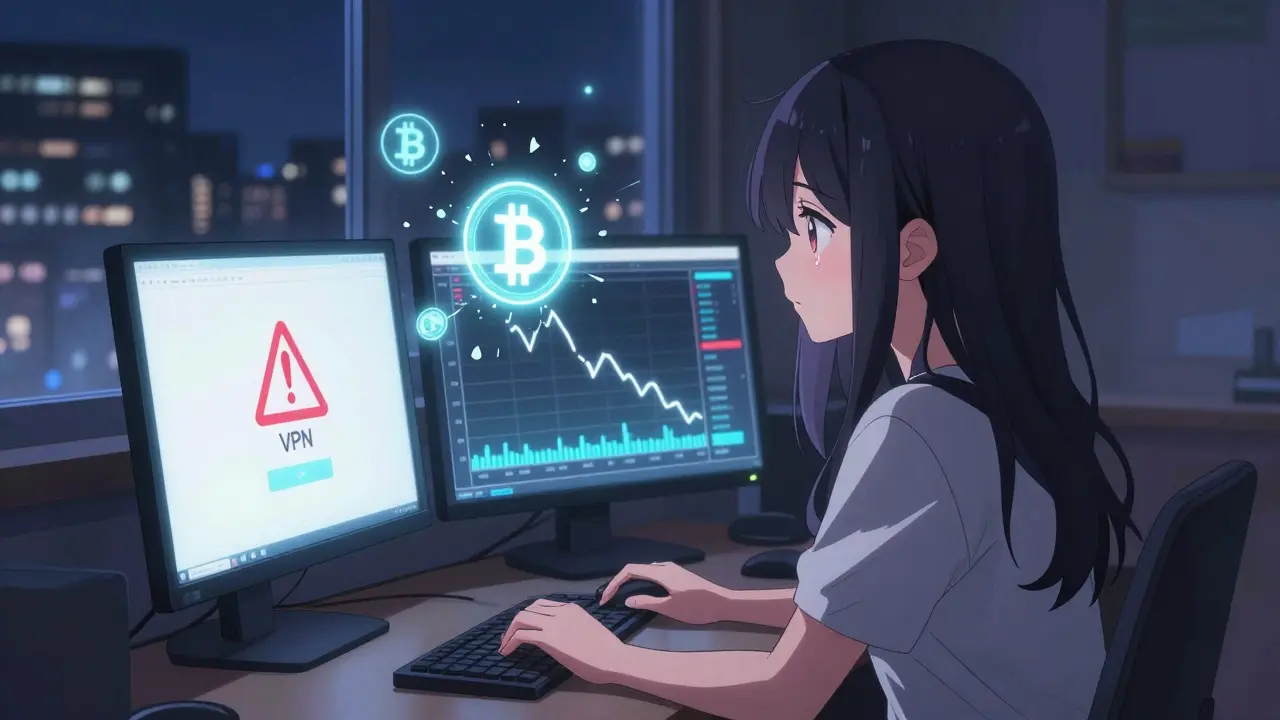
For Iranian crypto traders, using a VPN isn’t a luxury-it’s a necessity. But as detection tools get smarter, that lifeline is turning into a ticking time bomb. What used to be a simple way to bypass restrictions now carries real risk: frozen accounts, lost funds, and even legal consequences. The game has changed, and the rules are no longer in the trader’s favor.
How Iran’s Crypto Scene Got to This Point
Iran’s crypto ecosystem didn’t grow overnight. It emerged from necessity. With strict currency controls, inflation hitting over 40% in 2024, and access to global banking cut off by sanctions, Iranians turned to Bitcoin, Ethereum, and TRON as a way to preserve value. Domestic platforms like Nobitex is Iran’s largest cryptocurrency exchange, processing over 87% of all Iranian crypto transactions in 2025 became central hubs. But even these platforms weren’t safe. In October 2024, a major security breach exposed user wallet data, and the platform was later linked to warrantless surveillance by Iranian authorities. That shattered trust. People started fleeing to international exchanges like Binance and Kraken-only to find those platforms had started blocking Iranian IPs.That’s where VPNs came in. By masking their real location, users could log in as if they were in Germany, Canada, or the U.S. For years, it worked. Binance, in particular, was easy to use-no ID required, just an email. Traders joked about "IRAN BOYS" in internal chats. But that era ended in late 2021 when Binance rolled out strict KYC rules. Suddenly, millions of Iranian users were locked out. Some lost access to tens of thousands of dollars in crypto. And it wasn’t just Binance. Other exchanges followed suit, building detection systems that went far beyond simple IP blocking.
What Detection Looks Like Today
Modern exchanges don’t just check your IP. They watch everything. Your device fingerprint. The time you log in. The pattern of your trades. Where your funds are sent. Even the way your keyboard moves. These signals, when combined, create a profile that’s hard to fake-even with a VPN.Here’s what actually triggers a ban:
- VPN connection drops mid-trade-exposing your Iranian IP instantly
- Using a free VPN with weak encryption (many sell user data)
- Consistently sending funds to wallets linked to Nobitex or other Iranian platforms
- Trading only on TRON network, where 87% of Iranian activity is concentrated
- Using the same device or browser profile across multiple accounts
Blockchain analytics firms like Chainalysis and TRONScan now have Iranian-specific monitoring programs. They don’t just track transactions-they map patterns. For example, if a wallet receives small deposits from 20 different Iranian IP addresses over a week, then sends a large lump sum to a Binance deposit address, it gets flagged. No VPN can hide that kind of behavioral fingerprint.
The Underground Economy: Fake IDs, Foreign SIMs, and IBANs
As detection tightened, a black market exploded. Iranian traders didn’t just give up-they adapted. Now, a thriving underground industry offers full circumvention packages:- Foreign IBANs are International Bank Account Numbers from countries like the UAE, Turkey, or Armenia, used to bypass bank restrictions
- Real SIM cards from abroad for OTP verification (sent via smuggled phones or relay services)
- Forged residency documents (driver’s licenses, utility bills) that pass basic KYC checks
- VPN bundles that include dedicated IPs from non-blocked countries
These services cost anywhere from $50 to $300 per month. Some are run by former Iranian tech workers who fled the country. Others are scams. Many users report losing money to fake providers who stole their crypto after collecting payment. The demand is high-$3.7 billion in crypto flowed into Iran between January and July 2025, even as overall volumes dropped 11% from the year before.
Why Free VPNs Are a Death Trap
The most common mistake? Using free VPNs. They seem harmless-cheap, easy, no credit card needed. But here’s what really happens:- They log your traffic and sell it to third parties-sometimes directly to Iranian authorities
- They have weak encryption, making it easy for exchanges to intercept your data
- They’re overloaded with Iranian users, causing constant disconnects
- They often inject tracking scripts into your browser
One trader in Shiraz lost $18,000 after using a free VPN that leaked his real IP during a withdrawal. His account was frozen, and the exchange refused to help because he’d violated their terms. He later found out the VPN provider had been selling Iranian user data to a local cybersecurity firm. Free isn’t free-it’s a trap.

What Happens When You Get Caught
Getting flagged isn’t just about losing access. In 2025, Iranian authorities froze over one million bank accounts linked to crypto activity. The Central Bank of Iran doesn’t just block crypto-it treats it as a threat to monetary sovereignty. The Ministry of Energy monitors electricity usage to catch illegal miners. Iran Cyber Police (FATA) investigates crypto-related fraud and money laundering. Even if you’re not mining or trading illegally, using a VPN to access foreign exchanges can land you on a watchlist.Some users report being summoned for questioning. Others had their phones seized. A few were fined under anti-money laundering laws. There are no public records of prison sentences yet-but the legal gray zone is expanding fast.
The TRON Factor: A Hidden Vulnerability
Over $2 billion of the $3 billion processed through Nobitex in 2025 moved via the TRON network. Why? Because TRON transactions are faster and cheaper than Ethereum. But that’s also why it’s a target. Blockchain analysts can easily spot TRON wallets tied to Iranian exchanges. Once one wallet is flagged, the entire cluster gets mapped. Even if you use a different exchange, if you send funds to a TRON address that’s linked to Nobitex, you’re at risk.Exchanges now use cluster analysis to trace connections. If your wallet has ever received a transaction from a Nobitex-linked address-even years ago-it’s flagged. That means past activity can haunt you long after you’ve switched platforms.
What’s Next? Hamster Combat and the Shift to Alternative Earning
As exchanges tighten, Iranians are turning to new methods. One example: Hamster Combat is a mobile crypto-mining game that lets users earn small amounts of cryptocurrency through daily interactions, bypassing traditional exchange monitoring. It’s not a replacement for serious trading-but for people who just want to earn a few dollars without risking their account, it’s growing fast. Scammers use it too, but so do teachers, doctors, and students. It’s a sign that the crypto ecosystem is evolving beyond exchanges entirely.
Can You Still Use a VPN? Yes-but Only If You Do This
You can still use a VPN. But you need to treat it like a high-stakes operation:- Use only paid, reputable VPNs with a no-logs policy (NordVPN, ProtonVPN, Mullvad)
- Never use the same device for both personal use and crypto trading
- Always use a separate browser profile with clean cookies and no extensions
- Switch IPs between trades-don’t stay on one server for more than 24 hours
- Never send funds to wallets linked to Iranian exchanges
- Use hardware wallets to store funds offline
And never, ever use a free VPN. Ever.
The Bigger Picture
This isn’t just about Iran. It’s about what happens when a government and global financial systems collide. Iran’s crypto users are at the front line of a new kind of digital war-one fought with blockchain analytics, behavioral tracking, and identity verification. The tools used to monitor them are being refined and sold to other countries. What’s happening in Tehran today could be the blueprint for restrictions in Brazil, Nigeria, or Venezuela tomorrow.For now, Iranian traders are still finding ways to survive. But the margin for error is shrinking. Every connection drop, every reused device, every free VPN could be the one that costs you everything.
Is it illegal to use a VPN for crypto in Iran?
It’s not explicitly illegal to use a VPN, but using it to access foreign cryptocurrency exchanges violates Iran’s banking and foreign exchange laws. The Central Bank of Iran prohibits crypto transactions, and using a VPN to bypass restrictions can be treated as financial fraud or circumvention of sanctions. Enforcement varies, but the risk of account freezes, fines, or investigation is real.
Can I still trade crypto in Iran without a VPN?
Yes-but only on domestic platforms like Nobitex. These platforms are heavily monitored, require full KYC, and are linked to Iranian government surveillance. Trading on them means giving up anonymity and risking exposure to state monitoring. Many traders avoid them after the 2024 security breach that exposed user wallet data.
Why do exchanges block Iranian users?
Exchanges block Iranian users because of international sanctions and compliance pressure. If they allow Iranian users without strict KYC, they risk violating U.S. and EU sanctions, which can lead to massive fines or being cut off from global banking systems. Most exchanges now use automated systems to detect Iranian IPs and block access before any transaction occurs.
Are there safe VPNs for Iranian crypto traders?
Yes-but only a few. Paid services like NordVPN, ProtonVPN, and Mullvad have strong no-logs policies and don’t sell user data. Avoid free VPNs at all costs. Even paid services aren’t foolproof: if you use them carelessly (reusing devices, connecting from the same IP too often), exchanges can still detect you through behavioral analysis.
What should I do if my crypto account gets frozen?
If your account is frozen, don’t panic-but don’t contact customer support either. Most exchanges won’t help Iranian users, even if you’re innocent. Your best move is to secure your funds in a hardware wallet, stop using the compromised device, and avoid any further activity on that account. If you have backups of your seed phrase, you may be able to recover funds on a new platform-but only if you didn’t link the wallet to your identity.
Sarah Zakareckis
Let me break this down for y’all - VPNs aren’t just tools anymore, they’re tactical infrastructure. You’re not just masking your IP, you’re managing a multi-layered operational security posture. Think device fingerprinting, behavioral biometrics, transaction clustering - it’s all part of a adversarial ML model trained on Iranian user patterns. If you’re still using a shared server or static IP, you’re basically waving a red flag at Chainalysis. You need rotating dedicated IPs, burner browsers, and hardware wallets. No exceptions.
And don’t even get me started on TRON. 87% of Iranian traffic? That’s not a coincidence - it’s a honeypot. Every transaction from a Nobitex-linked wallet is a breadcrumb leading straight to your door. You want to survive? Isolate your on-ramps. Use ETH or LTC for liquidity moves. TRON is a death sentence waiting to be triggered.
Also - free VPNs? That’s not negligence, that’s self-sabotage. They’re not just selling your data - they’re feeding it directly to FATA. I’ve seen the leak logs. It’s not speculation. It’s documented.
Bottom line: This isn’t about tech. It’s about discipline. You treat crypto like a bank account, you die. Treat it like a covert op, you live.
Graham Smith
Wow. Just wow. The level of naive operational security here is almost poetic. You think NordVPN is going to save you? Please. The entire infrastructure of these exchanges is built on behavioral analytics - not IP blocking. Your mouse movements, your session duration, your trade frequency - these are your real fingerprints. A VPN doesn’t mask your identity, it just adds a layer of noise that sophisticated ML models can easily filter out.
And let’s be honest - the fact that you’re even asking about "safe" VPNs proves you’ve never read a single whitepaper on deanonymization techniques. You’re not a trader. You’re a tourist with a hardware wallet and a prayer.
Jerry Panson
Thank you for this comprehensive overview. The structural analysis of Iran’s crypto ecosystem is both sobering and illuminating. The convergence of macroeconomic pressures, regulatory enforcement, and technological countermeasures presents a textbook case study in digital sovereignty vs. financial autonomy.
I would only suggest that future iterations consider incorporating a brief section on the psychological toll of perpetual operational vigilance - the chronic stress of maintaining anonymity under constant surveillance. This is not merely a technical challenge; it is an existential one.
Katrina Smith
lol so u mean like… if i use a free vpn and then send money to nobitex i get arrested? 😂😂😂
Anastasia Danavath
this is wild 😭 i just used a free vpn for 2 years and now my account is frozen. i lost 12k. why did no one tell me?? 🤡
anshika garg
There is something deeply human in how people adapt when systems fail. Iran’s traders aren’t just circumventing laws - they’re rebuilding trust in a world where institutions have betrayed them. Every VPN, every foreign SIM, every hardware wallet is an act of quiet rebellion. Not violent. Not loud. Just persistent.
I think of my cousin in Delhi, who uses UPI to send small amounts to friends abroad to avoid capital controls. Same story. Different continent. Same desperation.
We are all just trying to hold onto something real in a world that keeps making money abstract.
Bruce Doucette
Oh wow, so you’re telling me people are still using free VPNs? Like, in 2025? Did you all skip the last 10 years of cybersecurity? You’re not "trading crypto" - you’re just handing your life savings to Iranian cyber police with a side of tracking scripts.
And TRON? Seriously? That’s like mailing your wallet address on a postcard and then wondering why someone stole your stuff.
Maybe stop trying to outsmart the system and start learning how to actually protect yourself. Or just give up. Either way, stop being a liability to everyone else trying to stay safe.
Marie Vernon
Thank you for sharing this. It’s easy to forget that behind every statistic - $3.7B, 87%, 1 million frozen accounts - there are real people: teachers, nurses, students, parents trying to feed their families.
I’ve worked with communities in Venezuela and Nigeria where similar dynamics play out. The tools change - but the hunger for dignity doesn’t.
Maybe the real question isn’t how to hide better… but why the world keeps forcing people into hiding just to survive. We need more than tech solutions. We need justice.
Billy Karna
Let’s go deeper on the behavioral fingerprinting point because this is where most people get it wrong. Exchanges don’t just track your IP - they build a temporal profile. Your login time? If you’re consistently logging in between 11 PM and 2 AM Tehran time, that’s a pattern. Your trade frequency? If you always trade in 500 USDT increments after a local currency devaluation spike, that’s a signature. Your withdrawal destinations? If you always send to wallets that have previously interacted with Nobitex, even indirectly, you’re tagged.
It’s not about one mistake - it’s about the accumulation of micro-behaviors. A single drop in your VPN connection exposes your real location - but your real risk comes from the 200 other times you didn’t change your browser profile, reused the same device, or sent a tiny dust transaction to a Nobitex-linked wallet three years ago.
And yes - TRON is the Achilles heel. Its low fees and fast finality make it ideal for micro-transactions, which is exactly why Iranian users adopted it. But that also means every TRON wallet with more than 5 inbound transactions from Iranian IPs is now flagged in Chainalysis’ Iranian cluster map. There’s no way around it. The entire network is a heatmap.
So what’s left? You need to compartmentalize: one device, one browser, one IP - never reused. Use a dedicated mobile hotspot with a foreign SIM. Never touch your personal accounts from your trading device. Use a hardware wallet with no metadata attached. And above all - never, ever, ever use a free service. Even if it says "no logs," it’s lying. The metadata leaks are inevitable.
Arlene Miles
You’re all missing the point. This isn’t about tech. It’s about power. The same systems that block Iranian users are being sold to Brazil, Nigeria, Venezuela - and soon, they’ll be used against the poor, the marginalized, the dissenters everywhere.
Iran’s traders aren’t criminals. They’re the canaries in the coal mine. Every KYC requirement, every IP block, every behavioral algorithm - this is the future of global finance. And if we don’t push back now, we’ll all be trapped in digital ghettos, unable to move money without government approval.
So yes - use NordVPN. Use hardware wallets. But also - organize. Support decentralized alternatives. Fund privacy tools. Demand open protocols. Because if we let them build this surveillance architecture on the backs of Iranians, they’ll use it on us next.
shreya gupta
While I appreciate the technical depth of this post, I must emphasize that the underlying issue is not technological but systemic. The use of VPNs is merely a symptom of deeper structural failures: inflation, sanctions, and the erosion of financial sovereignty. The real solution lies not in circumvention, but in reform - of both domestic monetary policy and international financial governance.
Until then, individuals will continue to take matters into their own hands. But we must not romanticize risk. Every transaction carries moral weight - and every act of evasion, however noble, contributes to a fragmented, unstable ecosystem.
iam jacob
i just lost everything… i trusted a "free" vpn because i was broke… now i can’t sleep… i feel so stupid…
is there any way to get my money back? i just wanted to buy bread for my kids…
Jesse Pals
yo this is wild 🤯 i’ve been using Mullvad for 2 years and never had a problem - but i switched to a new burner phone and a fresh browser profile last month and now i’m feeling like a hacker in a movie 😎
also i use hamster combat now to earn like 0.5 HAM daily - not life changing but it’s a vibe and no one can track it. free money from a game? yes please 🐹💸
and to everyone still using free vpn’s… bro you’re basically giving your crypto to a guy in a basement in iran with a spreadsheet. just stop.
Sarah Zakareckis
Responding to @2118 - I’m so sorry you’re going through this. You’re not stupid. You were doing what millions do - trying to survive with zero safety nets. There’s no shame in that.
But here’s the cold truth: recovery is nearly impossible. Exchanges won’t help. Authorities won’t care. Your best move? Secure your seed phrase if you have it. Move everything to a new wallet on a clean device. Never reuse that compromised account. And if you can - start small again. Use Hamster Combat. Earn micro amounts. Build back slowly. You’re not alone. We’re all still fighting this war - one transaction at a time.