

Back in 2021, Kazakhstan was the world’s top Bitcoin mining hub. Miners flooded in, lured by cheap electricity and lax rules. But by 2023, the lights were going out in homes, hospitals, and schools because of power shortages. The cause? Illegal crypto mining rigs running nonstop, siphoning off enough electricity to power entire cities. What followed wasn’t just a policy tweak-it was a full-scale government crackdown that reshaped the entire industry.
The Energy Crisis That Changed Everything
In early 2022, power outages hit Kazakhstan hard. In cities like Almaty and Ust-Kamenogorsk, residents faced daily blackouts. Hospitals ran on generators. Schools closed. The government scrambled for answers. Investigations revealed that unregulated mining farms were consuming up to 15% of the country’s total electricity-sometimes more during winter peaks. One operation in East Kazakhstan Oblast alone was using 50 megawatt-hours of power. That’s enough to supply 60,000 people. And it wasn’t even legal.Utility workers were in on it. Some were diverting power meant for neighborhoods straight to hidden mining farms. The money from these operations flowed into luxury apartments in Astana and high-end cars. By mid-2023, the government had had enough. The mining boom had become a national emergency.
Legal Mining Now Requires a License-And a Lot of Paperwork
Kazakhstan didn’t ban crypto mining. It just made it nearly impossible to do it without permission. As of 2025, you can only mine if you have a license from the Astana Financial Services Authority (AFSA). There are only 84 active licenses issued so far. Each miner must register every single machine with the National Association of Blockchain and Data Center Industry. No exceptions. No gray areas.Miners now have to buy electricity through a state-controlled platform run by the Ministry of Energy. And you can’t just order as much as you want. Each transaction is capped at one megawatt-hour. That’s roughly enough to run 50 high-end ASIC miners for a day. If you need more, you need to justify it-and prove you’re not hoarding power.
75% of Your Crypto Must Be Sold Locally
Here’s where it gets even tighter. If you mine Bitcoin or Ethereum in Kazakhstan, you’re required to sell 75% of your output on licensed exchanges inside the Astana International Financial Centre (AIFC). That’s up from 50% in 2024. The goal? Keep the profits inside the country’s financial system. It forces miners to pay taxes, report income, and stop laundering money through offshore wallets.It also means you can’t just dump your coins on Binance or Coinbase and walk away. You have to go through a regulated local platform. That’s a big shift for miners used to global liquidity. But it’s also a way for the government to track every transaction-and collect taxes.

15% Tax and the Risk of Losing Everything
Kazakhstan doesn’t just want control-it wants its cut. All legal mining operations pay a flat 15% tax on profits. That’s higher than many other mining jurisdictions, but it’s still lower than the penalty for breaking the rules.Get caught mining without a license? Your equipment gets seized. Your bank accounts frozen. Your property confiscated. In 2024, authorities seized over 4,000 mining rigs and shut down 36 unlicensed exchanges. They also raided homes in Astana, taking luxury apartments bought with illicit mining profits. One case involved a mining operator who bought a $2 million penthouse using Bitcoin mined illegally. The apartment was seized within weeks of the raid.
Renewables Are the New Lifeline
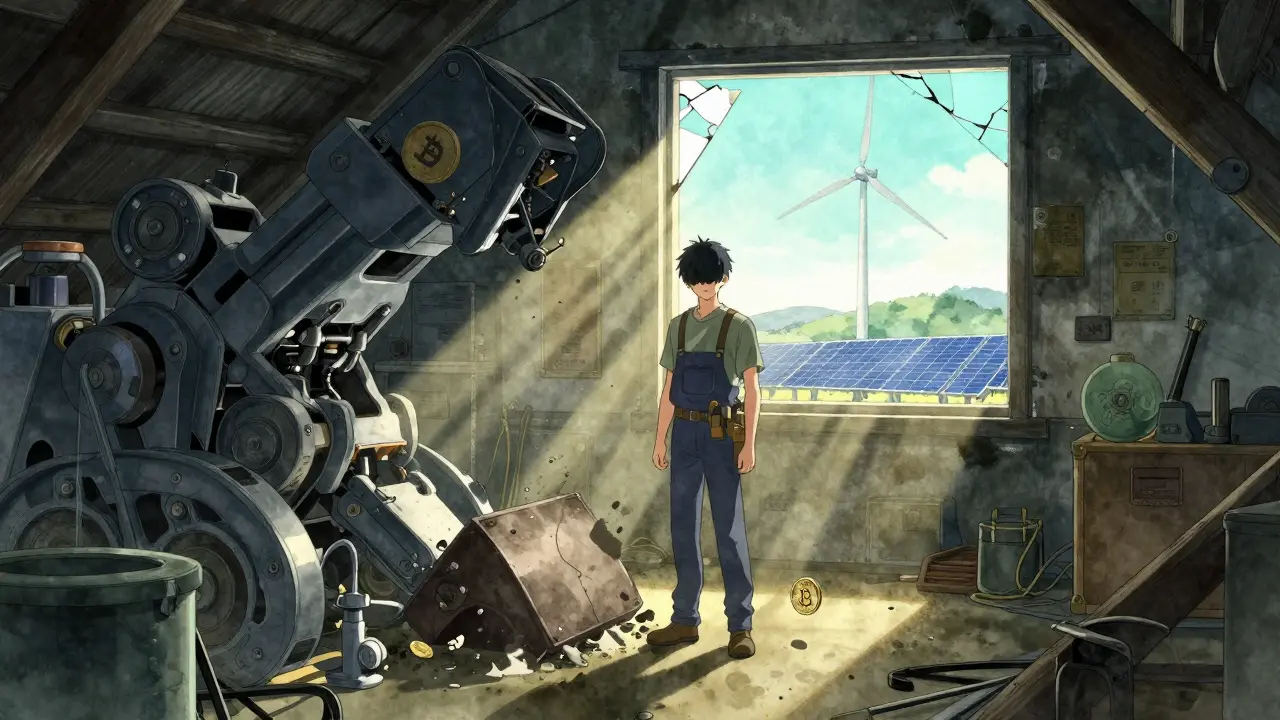
The government knows it can’t keep shutting down miners forever. So it’s trying to make mining part of the solution-not the problem. A new proposal called the 70/30 energy program invites foreign investors to build new thermal power plants. In return, 70% of the power goes to the national grid, and 30% is reserved for licensed miners.That’s not the only plan. Solar and wind farms are being built specifically to power mining operations. In the Altai region, a 100-megawatt solar farm now supplies three licensed mining farms. The idea? Use renewable energy that’s otherwise wasted during low-demand hours. It’s a smart pivot-turning environmental concerns into a business model.
Who’s Still Mining in Kazakhstan Today?
The big players are still there. Companies from the U.S., Canada, and Russia have set up shop under the new rules. They’ve paid the fees, registered their rigs, and adapted to the 75% sales rule. Some even say the system is working better now. No more blackouts. No more corruption. Just clean, regulated mining.But the small operators? Most are gone. The cost of compliance-licenses, taxes, mandatory sales, equipment registration-is too high for hobbyists or solo miners. What’s left is a leaner, more professional industry. Think of it like the difference between a garage band and a signed label act.
What Happens If You Try to Work Around the Rules?
Some miners still try. They hide rigs in basements. They bribe local officials. They use fake company names. But the government’s surveillance is now sophisticated. The Financial Monitoring Agency (FMA) and National Security Committee (KNB) track energy usage patterns. If a building’s power draw spikes at night and never drops, they come knocking.Last year, a mining ring in Shymkent was busted after their electricity usage matched the profile of a known illegal farm. They were using 120 kilowatts-enough for 1,000 miners-without a license. The operators got prison sentences. Their equipment was melted down and sold as scrap.
The message is clear: if you’re not licensed, you’re not just breaking the law-you’re risking your freedom.
How Kazakhstan Compares to Other Countries
Russia has a similar approach-register your rigs, pay taxes, no anonymous mining. The U.S. is patchy, with states like Texas letting miners run wild while New York bans them outright. But Kazakhstan is one of the few countries that turned a crisis into a blueprint. It didn’t just ban mining. It built a system to control it.France is even experimenting with using nuclear power surpluses for mining. But no other country has tied mining so tightly to its national grid, tax system, and financial infrastructure. Kazakhstan’s model is becoming a case study in how to manage crypto without killing innovation.
What’s Next for Kazakhstan’s Crypto Mining Scene?
The government is pushing for a national digital asset registry. By 2027, every mining rig, every wallet, every transaction might be tracked in real time. There’s talk of requiring miners to hold a portion of their assets on local exchanges-just to keep capital flowing through the economy.Legislators like Ekaterina Smyshlyaeva are pushing to decriminalize crypto trading for users on licensed platforms. That could mean more people buying Bitcoin legally, not just mining it. The goal? Make Kazakhstan a hub for regulated digital finance-not just energy-hungry hardware.
For now, mining here is possible. But it’s not easy. It’s not cheap. And it’s not anonymous. If you’re thinking about mining in Kazakhstan, you’re not just buying electricity-you’re buying into a state-controlled ecosystem. And if you don’t play by the rules, you won’t be mining for long.
Steven Dilla
This is wild. I mean, 75% of your crypto has to stay in-country? That’s insane. I get why they did it, but damn. My buddy tried to mine in Kazakhstan last year and got his whole rig seized. He’s still mad. 😤
Akhil Mathew
Honestly this is one of the few places that actually got it right. No more blackouts, no more corrupt utility workers, and now they’re using renewable energy to power miners? Smart. Other countries are still arguing about whether crypto is evil or not. Kazakhstan just fixed it.
Ramona Langthaler
So now the state owns your profits? Thats not regulation thats socialism with bitcoin. Theyre just trying to control everything and call it progress. America would never let this happen and thank god for that
Kevin Thomas
If you're a solo miner with a few rigs, this system crushes you. But if you're a legit company with capital? It's actually cleaner now. No more shady ops, no more power theft. The 15% tax is steep but way better than losing everything to a raid. This is capitalism with guardrails.
Robert Mills
Kazakhstan won. 💪 No more blackouts. No more corruption. Just clean, taxed, regulated mining. The future is here.
Andrea Demontis
It’s fascinating how a crisis forced a philosophical shift-from mining as an anarchic, borderless activity to mining as a public utility. The state didn’t just regulate it; it redefined mining as a civic responsibility. You’re not just running hardware-you’re participating in national infrastructure. That’s a radical reimagining of what crypto can be. It’s not about decentralization anymore. It’s about integration. And maybe that’s the next evolution. Not ‘no middleman’ but ‘middleman you can’t avoid’.
Joseph Pietrasik
75% sale rule? More like 75% theft rule. And who says the government isn't hoarding power? Theyre just doing it legally now. Also the whole 'renewables for miners' thing is just greenwashing. Solar farms dont run 24/7 and they know it
Raju Bhagat
OMG this is the most dramatic thing I've read all week 😭 I mean imagine your whole life's work getting melted down into scrap metal because you forgot to file Form 7B-Alpha? I cried for 3 days straight when I read about that penthouse seizure
laurence watson
I think this is actually kind of beautiful. They turned a disaster into something structured. No more kids studying by flashlight. No more hospitals on generators. And now miners are helping fund solar farms? That’s not control, that’s healing. It’s not perfect, but it’s progress.
Pamela Mainama
Finally someone did it right. Power first, mining second.
Tressie Trezza
I keep thinking about the human cost. The guy who bought that penthouse with illicit Bitcoin-was he just greedy, or was he the only one who saw a way out of poverty? And now he’s got nothing. The system fixed the grid, but did it fix justice? Or did it just replace one kind of exploitation with another?
Mark Ganim
THEY SEIZED 4,000 MINING RIGS?!?!?!?!?!?!?!? And then MELTED THEM DOWN?!?!?!?!? That’s not policy-that’s a war crime against innovation!!! The state is burning the future for a few extra watts of grid stability!!!
Rob Duber
This whole thing is like watching a mob boss take over a nightclub and turn it into a fancy jazz lounge. Same music, same people, but now you gotta wear a tie and tip the bouncer 15% of your earnings. And if you try to sneak in a bottle? They’ll drag you out by your hair and toss your speakers into a dumpster fire.
Gary Gately
so they make you sell 75% of your btc on their exchange? lol who even uses that? its prob like 10% of the liquidity of binance. miners are gonna get wrecked on fees and slippage
Brandon Vaidyanathan
This is what happens when you let crypto run wild. Now they’re forcing miners to be little tax drones. Pathetic. Real miners don’t need licenses. Real miners don’t ask permission. They just mine. And if the lights go out? So what? Free market baby.
Gareth Fitzjohn
An interesting case study. Not perfect, but pragmatic. The state prioritised basic services over speculative energy use. That’s a reasonable trade-off. The renewable integration is a thoughtful touch.
Katie Teresi
Kazakhstan is a dictatorship now. They own your coins. They own your hardware. They own your life. This is not regulation. This is slavery with a tax ID.
Moray Wallace
The fact that they're tying mining to renewable infrastructure is genuinely innovative. It's not just about control-it's about sustainability. That’s rare in this space. Most countries are either banning it or ignoring it. This is actually building something.