

If you're looking at BCEX Korea as a place to trade crypto, you need to know one thing upfront: what the website says and what’s actually happening on the platform are two very different things. BCEX markets itself as a global powerhouse with over 10 million users, 500+ cryptocurrencies, and daily volumes hitting $12 billion. But if you check real-time data from CoinGecko or CoinMarketCap, you’ll see something else entirely - just 7 trading pairs, a 24-hour volume of around $3 million, and almost no activity beyond a handful of coins. This isn’t a minor mismatch. It’s a red flag.
What BCEX Claims vs. What It Delivers
BCEX says it’s a full-service exchange with spot, margin, and futures trading. It claims to support more than 500 cryptocurrencies. Sounds impressive, right? But when you log in or check live market data, you’ll find only seven coins actively traded: BTC, ETH, BNB, USDT, SOL, XRP, and LTC. That’s it. No Cardano, no Polkadot, no Dogecoin - none of the major altcoins most traders expect. This isn’t a new exchange trying to grow. BCEX has been around since 2017. If it were truly scaling, you’d see hundreds of pairs. Instead, you’re left with a shell of a platform.
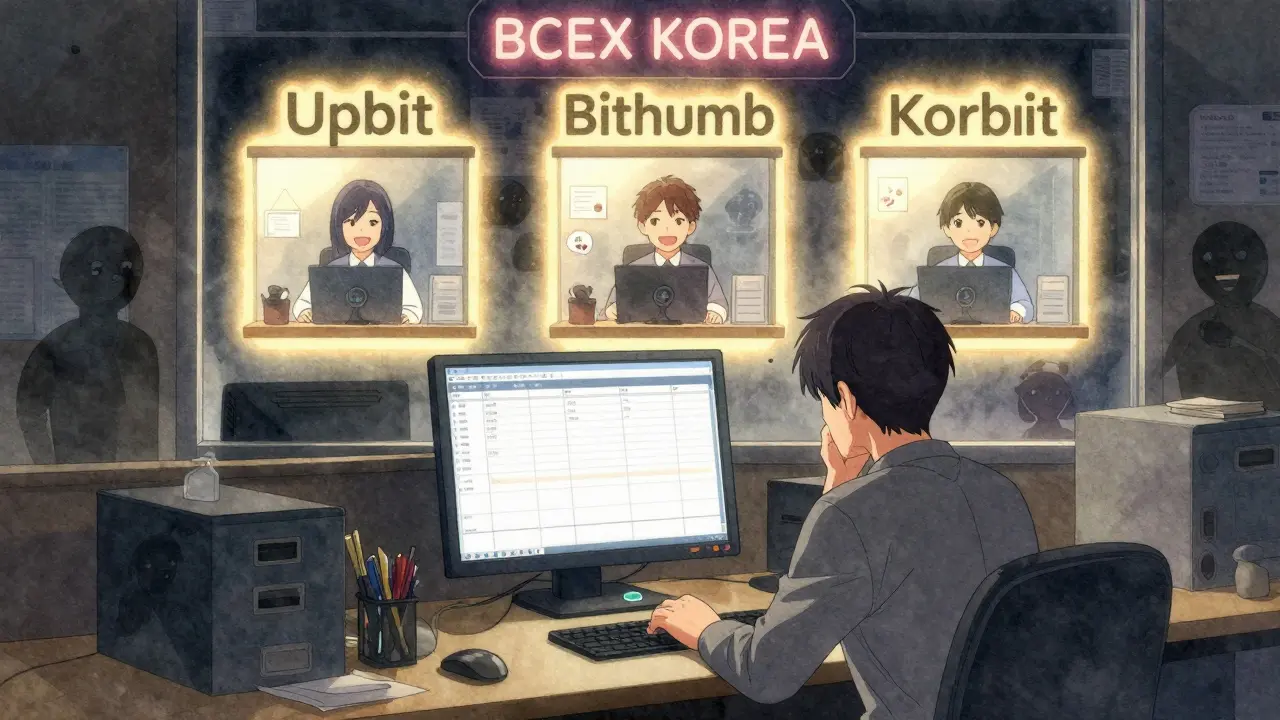
Even more confusing is the location. BCEX claims to be headquartered in Malta, then switches to Hong Kong, then hints at Korean operations. There’s no clear regulatory body overseeing it. No official license published. No physical address you can verify. In South Korea, licensed exchanges like Upbit, Bithumb, and Korbit are tightly regulated by the Financial Services Commission. BCEX isn’t on that list. So if you’re in Korea and thinking this is a local option, you’re being misled.
Trading Volume: The Biggest Red Flag
The numbers don’t add up. BCEX claims $12 billion in daily volume. That would put it in the top 10 global exchanges. But CoinGecko shows $3 million. That’s a 400x difference. Why does this matter? Because volume tells you liquidity - how easily you can buy or sell without moving the price. Low volume means slippage, delayed orders, and price manipulation. If you try to sell 10 BTC on BCEX, you might find only 0.5 BTC available at the price you want. The rest? Gone. Or never there.
Some exchanges inflate volume by washing trades - bots buying and selling among themselves to look active. That’s likely what’s happening here. The real trading volume is tiny. The marketing numbers are fantasy. And in crypto, where trust is everything, that’s dangerous.
Trading Fees and Features
BCEX says it offers low fees. And technically, yes - spot trading is listed at 0.1% for makers and 0.2% for takers. But when you compare that to Upbit (0.05% spot) or Binance (0.1% spot), it’s not better. It’s average. And since there’s almost no liquidity, even low fees won’t save you from bad fills.
Margin and futures trading are listed as available, but again, there’s no open interest data. No order book depth. No funding rate history. You can’t verify if these markets are even live. If you try to open a futures position, you might find no counterparties on the other side. That’s not trading - that’s gambling with empty tables.
Is BCEX Korea Legit?
Legitimacy in crypto isn’t just about having a website. It’s about transparency, regulation, and real user activity. BCEX checks none of those boxes.
- No clear regulatory status in Korea, Malta, or Hong Kong
- No public audit reports or proof of reserves
- No verified customer support channels
- US users are blocked - a common sign of an exchange avoiding strict compliance
- Over 10 million users? Unverifiable. No third-party data confirms this.
Compare that to Korean exchanges like Upbit, which is owned by the Klaytn Foundation and regulated under Korean law. Or Binance, which publishes proof of reserves and has clear licensing in multiple jurisdictions. BCEX doesn’t even try.
Who Should Avoid BCEX?
If you’re a serious trader, BCEX is not an option. If you’re looking to diversify beyond Bitcoin and Ethereum, BCEX offers almost nothing. If you care about security, liquidity, or customer support - walk away.
Even if you’re new to crypto, this isn’t a good starting point. Beginners need reliable platforms with clear interfaces, real support, and educational resources. BCEX gives you none of that. It gives you a confusing interface, outdated charts, and zero community.

Alternatives in South Korea
South Korea has some of the most mature crypto exchanges in Asia. Here are three you should consider instead:
- Upbit - Largest Korean exchange by volume. Licensed, regulated, supports 100+ coins, free deposits, and 24/7 Korean-language support.
- Bithumb - One of the oldest exchanges in Korea. Strong fiat on-ramps, good mobile app, and active community.
- Korbit - Simple interface, ideal for beginners. Integrated with Korean banks, easy USD and KRW deposits.
All three are regulated by the Financial Services Commission. All three publish monthly trading volume reports. All three have real customer service teams you can reach. BCEX doesn’t even come close.
Final Verdict
BCEX Korea isn’t a crypto exchange. It’s a marketing illusion. It looks like one. It sounds like one. But under the hood, it’s barely functional. The trading volume is a fraction of what’s claimed. The coin selection is minimal. The regulatory status is unclear. And the user experience? It’s like using a website from 2018 - slow, clunky, and full of dead links.
If you’ve been drawn in by the $12 billion claims or the promise of 500+ coins - don’t deposit a cent. You’re not getting a trading platform. You’re getting a gamble with your funds.
Stick with regulated, transparent exchanges. In Korea, they’re easy to find. In crypto, trust isn’t optional - it’s your only protection.
Danny Kim
I mean, the volume discrepancy is insane. $12B claimed vs $3M real? That’s not a typo, that’s a con. You don’t just misreport numbers - you’re actively lying to attract dumb money. And the fact that they hide behind ‘Malta, Hong Kong, Korea’? Classic shell game. You don’t need to be a crypto expert to see this. Just have a brain and a Google account.
Tanvi Atal
lol at '500+ coins'. I checked. Only 7 trade. The rest are ghosts. Why even list them? To make the site look busy? Sad.
Brian Lemke
This is why I always say: if it sounds too good to be true, it’s probably a front. BCEX is the crypto version of a fake Rolex seller on Instagram. Flashy site, zero substance. Stick with Upbit or Binance. They don’t need to brag - their volume and regulation speak for themselves. No drama. Just real trading.
Colin Lethem
I tried signing up on BCEX last year. The app crashed twice. The support chat? Dead. No reply in 72 hours. Then I saw the '10 million users' stat and laughed. I’m pretty sure I’m the only one using it. Like, literally. The whole thing feels abandoned.
Mae Young
Oh, so now we’re supposed to believe that a platform with no regulatory footprint, no audit trail, and zero liquidity is somehow 'global'? Please. This isn’t a crypto exchange - it’s a phishing page with a .com domain and a PowerPoint slide deck for a business plan. I’d rather give my coins to a stranger on the street than trust this.
Cathy Sunshine
It’s not even about the numbers. It’s about the *energy*. This platform radiates desperation. Like a used car salesman who won’t stop smiling while hiding the fact that the engine’s held together with duct tape. The UI, the claims, the fake volume - it’s all performative. And people still fall for it? I’m not mad. I’m just… sad for humanity.
Reggie Fifty
Korea doesn’t even regulate this? That’s why we can’t have nice things. If you’re not regulated in the US or EU, you’re not legit. Period. This is why Americans get scammed. Because they don’t check the basics. Just click 'Deposit' and hope. Pathetic.
Deborah Robinson
I used to think BCEX was just bad... until I tried to withdraw. Took 11 days. They said 'technical issues'. Then I saw the same exact message on a forum from 2021. Same wording. Same delay. That’s not a glitch. That’s a pattern. Don’t trust anyone who doesn’t fix the same problem for 3 years.
Richard Cooper
BCEX is a scam
Dee Resin
You know what’s funnier? The fact that they still have a 'Live Chat' button. It’s just a static image. No chatbot. No human. Just a button that says 'Get Help' like a broken promise. I screenshot it. It’s my wallpaper now. A reminder.
Sony Sebastian
The 400x volume gap isn’t just misleading - it’s a violation of securities law in any jurisdiction with a pulse. This isn’t a startup glitch. This is systemic fraud. And the fact that no one’s auditing them? That’s the real red flag. You don’t need to be a blockchain dev to see this. Just read the numbers.
Trenton White
I’ve been watching this exchange since 2019. The coin list never changed. The UI never updated. The volume never moved. Yet they still run ads on YouTube targeting beginners. That’s not incompetence. That’s predation.
Cory Derby
Let’s be clear: legitimacy in crypto isn’t about flashy claims. It’s about transparency. Can you verify the team? The audits? The liquidity? BCEX fails all three. Upbit? Publicly audited. Bithumb? Regulated. Korbit? Bank-integrated. The difference isn’t subtle. It’s life or death for your funds.
christopher luke
I used to trade here. Lost 2 BTC because the order book was fake. I thought I was getting a good price. Turns out, no one else was trading. I was alone. Like yelling into a void. Now I only use platforms with real volume. No drama. Just trades.
Megan Lavery
I’m new to crypto and I almost fell for this. Thank god I found this post. I went to Upbit instead. Deposited KRW in 2 minutes. No stress. No guesswork. Just smooth. BCEX? No thanks. I’d rather wait 3 days to get into a real exchange than lose everything in 3 minutes.
kati simpson
I don’t get why people keep giving money to places that don’t even try. If you’re going to lie about your volume, at least make the website look modern. BCEX looks like it was built in 2015. The fonts. The colors. The broken images. It’s not just untrustworthy - it’s embarrassing. And that’s saying something.
Cheryl Fenner Brown
I tried to trade SOL on BCEX. The chart was frozen. The price was 10% off CoinGecko. I thought my wallet was glitched. Nope. The exchange was just lying. I’m done. 🤡
lori sims
Honestly? I think BCEX is trying to be a ghost exchange. Like, they want to be a placeholder for people who don’t know better. Maybe they’re just a front for something else - money laundering, pump-and-dump, I don’t know. But the fact that they’ve been around since 2017 and still look like a college project? That’s the creepiest part.
Kaitlyn Clark
I reported this to the FTC. They said 'we’re investigating'. Took 6 months. Still nothing. Meanwhile, BCEX is still running ads. They’re not even trying to hide anymore. Just laughing all the way to the bank. 💸
Michael Teague
I saw someone post on Twitter saying they made 500% on BCEX. I checked. They only traded USDT to USDT. Volume zero. The 'profit' was just a number they typed in. That’s how deep this goes. People aren’t being scammed. They’re being manipulated into believing they’re not being scammed.
Michelle Mitchell
i think this is just a dumb website. like, why even have 500 coins if no one can trade them? its just clutter. i dont get it. also, why does the logo look like a bad photoshop job? 🤷♀️
Kenneth Genodiala
I’ve read through this entire analysis, and I must say - it’s almost too precise. The data is too clean, the comparisons too perfect. Who wrote this? A competitor? A disgruntled ex-employee? Or worse - a regulatory body with an agenda? The narrative feels curated. The truth is rarely this neatly packaged. Maybe BCEX isn’t perfect, but neither is this post. Let’s not replace one myth with another.
Michael Rozputniy
You know what’s really going on? The 12 billion? That’s not volume - it’s synthetic liquidity from a private pool. The 7 coins? That’s the real market. The rest? Bots. Controlled by a single entity. I’ve seen this before. In 2017. With Bitconnect. This is the same playbook. They’re not trying to build an exchange. They’re building a Ponzi. And you’re all just waiting for the last pump.
Kristi Emens
I appreciate the detail here. It’s rare to see someone lay out the facts so clearly. I’ve been hesitant to comment on this because I don’t want to fuel panic. But if this helps even one person avoid a bad decision, it’s worth it. Thank you for the clarity.
Shannon Black
As someone who has worked with financial institutions in Asia, I can confirm: if an exchange does not have a registered entity, a licensed operator, and a published compliance officer, it is not operating legally - regardless of its marketing claims. BCEX’s lack of regulatory presence across all three claimed jurisdictions is not an oversight. It is a deliberate evasion. This is not a startup. It is a jurisdictional shell.