

Parrot USD (PAI) was never meant to be another USDT or USDC. It was supposed to be something wild: a stablecoin that didn’t hold dollars, but instead locked up the messy, volatile tokens you get when you provide liquidity to DeFi pools. The idea sounded clever on paper-why let your liquidity tokens sit idle when they could be turned into a dollar-stable coin? But in practice, PAI became a ghost story of the Solana DeFi boom.
How PAI Was Supposed to Work
Parrot USD launched in late 2021, right in the middle of Solana’s DeFi rush. While other stablecoins like DAI used ETH or real-world assets as collateral, PAI used something no one else dared to touch: LP tokens. These are the receipts you get when you deposit two crypto assets-like SOL and USDC-into a liquidity pool on a DEX like Raydium or Orca. They’re not cash. They’re not even really assets. They’re tickets to a game where the rules change every time the market moves.
The Parrot Protocol said you could lock your LP tokens into its system, and it would mint you PAI tokens-each worth $1. You could then use PAI to lend, borrow, or trade on its built-in vAMM (virtual automated market maker). The goal? Free up value trapped in liquidity pools without selling your position. It was like turning a frozen savings account into a spending card.
But here’s the catch: LP tokens aren’t stable. If the price of SOL drops 30%, your LP token’s value drops too. And if the pair you deposited in-say, SOL and USDT-starts drifting apart, your LP token becomes worth less than $1. So how could a coin backed by these unstable receipts stay pegged to $1? The answer: it couldn’t.
The Numbers Don’t Lie
By December 2025, PAI’s data looked like a broken spreadsheet.
- Price: $0.96 on Binance, $1.03 on LiveCoinWatch, $0.05 on LBank. One coin, three wildly different values.
- Circulating supply: 4.2 million on CoinGecko, 0 on CoinMarketCap.
- Market cap: $1.45 million on CoinGecko, $16.4 million in fully diluted value (FDV)-meaning almost all tokens are still locked away, unused.
- 24-hour trading volume: $202 on CoinGecko. That’s less than what a single whale might spend on a weekend NFT flip.
Compare that to DAI, which trades over $1 billion a day, or even FRAX, which holds $1.8 billion in market cap. PAI doesn’t just lag-it’s invisible in the same universe.
Why No One Uses It
There’s a reason you won’t find PAI on Coinbase, Kraken, or even most Solana-focused wallets. It trades on only three exchanges with almost zero liquidity. Try swapping 10,000 PAI? One user reported 15% slippage. That’s not a stablecoin. That’s gambling.
Even the people who built it stopped showing up. The official Parrot Protocol website hasn’t been updated since mid-2023. The GitHub repo hasn’t had a commit since August 2022. No new code. No new docs. No community calls. No Twitter updates. Just silence.
Reddit has three mentions of PAI in a year. Bitcointalk has two old threads. Trustpilot? Zero reviews. CoinSwitch has one positive comment: “Good concept, needs more liquidity.” That’s it.
The Regulatory Death Sentence
Even if PAI had worked, it wouldn’t have lasted.
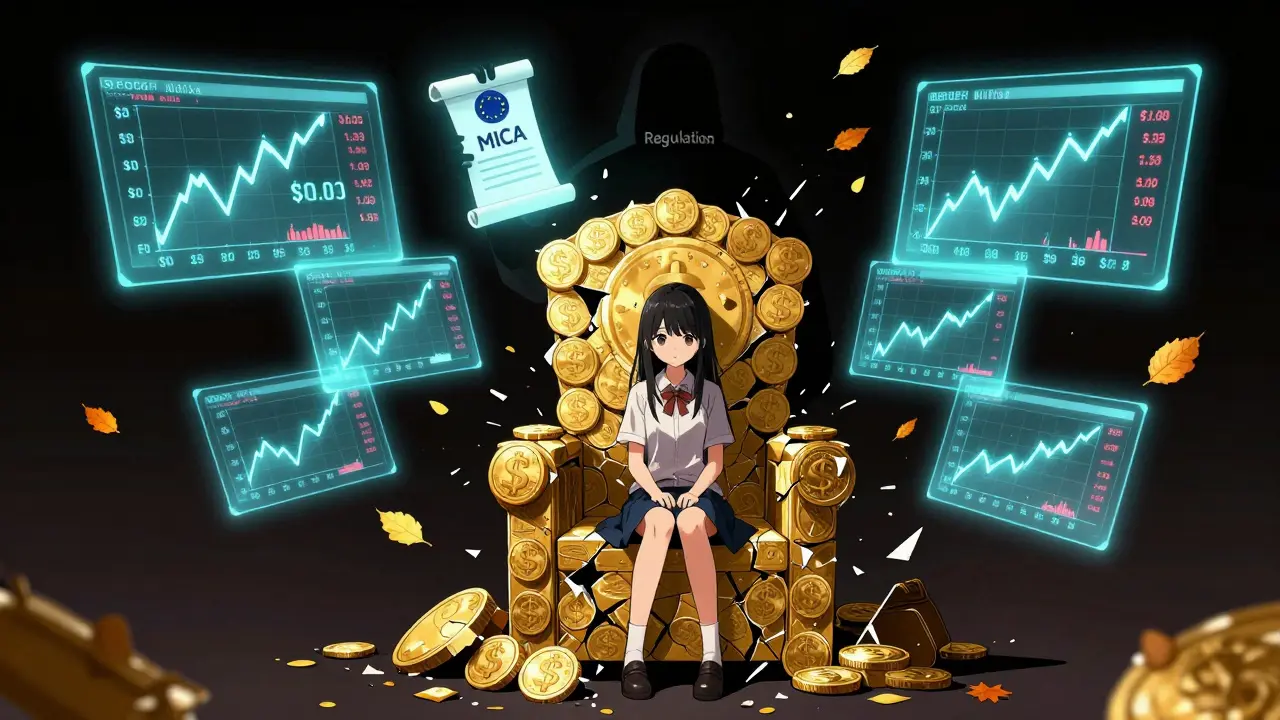
After the TerraUSD collapse in 2022, regulators around the world cracked down on algorithmic stablecoins. The EU’s MiCA regulations, which took full effect in 2025, require stablecoins to be backed 1:1 by cash, short-term government bonds, or other high-quality liquid assets. LP tokens? They’re volatile, illiquid, and unregulated. PAI fails every single test.
No bank will touch it. No merchant will accept it. No exchange will list it without legal risk. And without those three things, a stablecoin is just a digital collectible with a price tag.
What PAI Actually Is Today
PAI isn’t a currency. It’s not even a failed project. It’s a relic.
It’s a proof-of-concept that never got past the whitepaper. A speculative experiment built on the assumption that DeFi users would willingly risk their liquidity to mint a coin that couldn’t stay pegged. It’s a snapshot of Solana’s wild, anything-goes phase-when teams thought innovation meant ignoring basic financial rules.
There’s no recovery plan. No team revival. No roadmap update. The only thing moving is the price chart on low-volume exchanges, bouncing between $0.05 and $1.03 like a broken metronome.
Should You Buy PAI?
No.
Not because it’s a scam-though the lack of transparency is worrying. But because it doesn’t function. You can’t use it to pay for anything. You can’t lend it out reliably. You can’t swap it without losing 10-15% to slippage. And if you hold it, you’re holding a token with no real demand, no backing, and no future.
Even if you believe in Solana DeFi, there are better ways to play it: USDC on Solana, SOL staking, or even DAI via Wormhole. All of them have real liquidity, clear backing, and active development teams.
PAI? It’s a footnote. A cautionary tale. A reminder that in crypto, not every clever idea deserves to be built.
What Happens to PAI Next?
Nothing.
Without funding, without updates, without users, and without regulatory approval, PAI will keep drifting. Its price will keep swinging. Its market cap will keep shrinking. Eventually, it’ll vanish from exchanges. The 5,760 holders left will either forget about it or sell for pennies.
It won’t crash dramatically. It won’t make headlines. It’ll just fade out-quietly, like a dead terminal in a server room no one remembers to unplug.
Pamela Mainama
PAI was always a beautiful idea trapped in a broken system. Not every clever code deserves to live - some ideas are meant to be lessons, not legacies.
Nickole Fennell
I CAN’T BELIEVE PEOPLE STILL HAVE THIS IN THEIR WALLET. IT’S LIKE KEEPING A DEAD PHONE THAT STILL LIGHTS UP. YOU THINK IT’S WORKING BUT IT’S JUST GLOWING IN THE DARK.
Edward Drawde
lol who even still talks about pai? i thought it died in 2022. someone wake up the corpse.
Elle M
Of course it failed. Americans built it. You don’t build a stablecoin on LP tokens and expect the world to care. Europe had the sense to shut this down before it poisoned the ecosystem.
Rico Romano
Let’s be honest - PAI wasn’t a failure. It was an elegant critique of DeFi’s delusions. The fact that anyone thought LP tokens could be stable reveals how little most ‘builders’ understand finance.
Crystal Underwood
PAI was a rug pull disguised as innovation. LP tokens? That’s not collateral - that’s a time bomb wrapped in a whitepaper. And the team ghosted? Classic. You didn’t lose money - you lost faith in the entire Solana DeFi myth.
Brianne Hurley
I still have 8,000 PAI tokens. I keep them like a museum piece. Every time I open my wallet, I whisper, 'I believed.' Then I cry. Then I go drink. This isn’t crypto. This is emotional terrorism.
christal Rodriguez
Maybe PAI didn’t fail. Maybe the world just wasn’t ready for a stablecoin that reflected the true chaos of DeFi. We wanted safety. PAI gave us truth.
Calvin Tucker
The real tragedy isn’t PAI’s collapse - it’s that no one learned from it. The same people who backed PAI are now staking memecoins with 0% liquidity and calling it ‘decentralized finance.’
Gustavo Gonzalez
Let me break this down for the 5 people still holding PAI: Your tokens are worthless. The protocol is dead. The devs vanished. The market cap is a lie. You’re not ‘investing.’ You’re collecting digital dust. Stop romanticizing failure.
Mark Ganim
PAI… oh PAI… you were the beautiful, reckless child of Solana’s golden age - screaming into the void, daring the market to keep up… and when it didn’t? You didn’t scream louder… you just… stopped. No fanfare. No funeral. Just silence. That’s the real horror story.
mary irons
Did you know the PAI team was funded by a shell company linked to a Cayman Islands firm that also backed three other ‘stablecoins’ that vanished? This wasn’t a failed experiment - it was a coordinated extraction. The regulators didn’t kill PAI. The insiders did.
Akhil Mathew
Actually, I think PAI’s concept had potential if they’d used a dynamic collateral ratio and real-time oracle feeds. It’s not the idea that failed - it’s the execution. Still, I’m glad someone tried something different.
Aaron Poole
PAI reminds me of those early YouTube videos where people tried to make ‘smart’ gadgets out of Arduino and duct tape. Cool idea. Terrible engineering. But hey - at least someone tried. We need more of that, not just copy-paste DeFi clones.
Ramona Langthaler
why do people still care about this? its like mourning a broken toaster. move on. there are 1000 new coins to lose money on.
Sunil Srivastva
I used to run a small liquidity pool on Raydium. Saw PAI minting in real time. The slippage was wild. One day I tried to swap 500 PAI and got 420. I just laughed. That’s when I knew - this wasn’t finance. It was performance art.
Pamela Mainama
It’s not about the coin. It’s about what we believed in when we trusted it. That’s the real value - and it’s gone now.