
Have you ever seen a cute, big-toothed monster toy and wondered if it could make you rich? That’s exactly the question driving the LABUBU SOL cryptocurrency. If you’ve been scrolling through social media lately, you’ve probably noticed the frenzy around Labubu figures from the brand Toy2R. Now, that hype has spilled over into the crypto world with a token called LABUBU on the Solana blockchain. But before you rush to buy in, you need to understand what this coin actually is, where its value comes from, and why experts are sounding alarm bells.
This isn’t your typical tech-heavy cryptocurrency. It doesn’t solve a complex problem or power a decentralized application. Instead, it’s a pure play on internet culture and community sentiment. In this guide, we’ll break down the mechanics of LABUBU SOL, analyze its volatile market performance, and help you decide if this high-risk asset belongs in your portfolio-or if it’s better left as a novelty.
The Origins: From Plastic Toys to Blockchain Tokens
To understand LABUBU SOL is a Solana-based meme coin launched in 2024 that capitalizes on the cultural phenomenon surrounding Labubu collectible toys, you first have to look at the source material. Labubu is a character from "The Monsters" series by artist Kasing Lung, produced by the international toy brand Toy2R. The brand has seen explosive growth, with physical Labubu figurines becoming status symbols among collectors globally. The global market for these physical collectibles is estimated at over $1.2 billion.
In late 2024, during a resurgence of meme coins on the Solana network, anonymous developers created LABUBU SOL. The goal was simple: ride the wave of "community-driven cuteness." Unlike utility tokens that offer staking rewards or governance rights, LABUBU’s entire value proposition rests on social media virality, celebrity endorsements, and fan engagement. There is no official partnership between the LABUBU SOL token team and Toy2R. This lack of corporate backing is a critical detail. You are buying into a fan-made project, not an officially licensed product.
Technical Specs and Tokenomics: What Are You Actually Buying?
When you look under the hood of LABUBU SOL, the technical details reveal a classic meme coin structure. Here is what the data shows as of late 2025:
- Blockchain: Exclusively operates on the Solana blockchain, known for fast transactions and low fees.
- Total Supply: Fixed at approximately 997.7 million tokens. All tokens were circulating immediately upon launch, meaning there are no hidden reserves waiting to be dumped on the market later.
- Transaction Taxes: Zero percent. You don’t pay extra fees when buying or selling, which is attractive to traders but offers no funding for development teams.
- Liquidity: The team claims liquidity is locked, but independent verification remains difficult for anonymous projects.
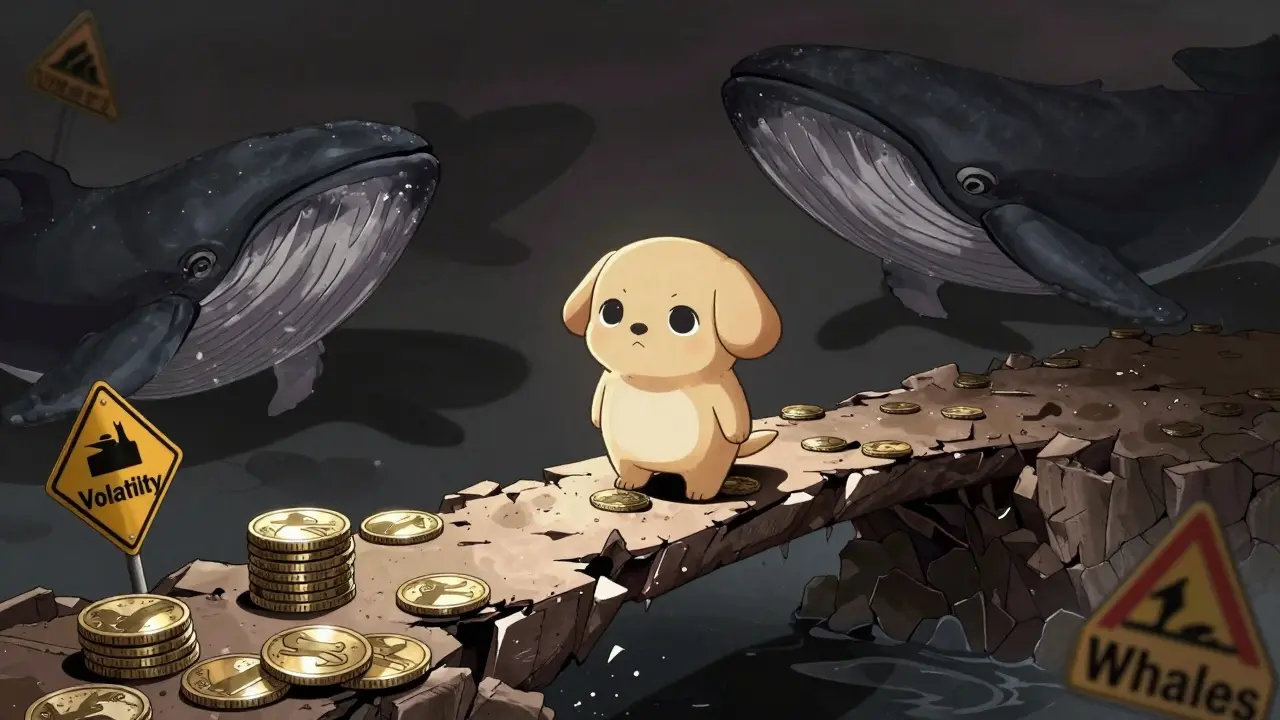
The absence of transaction taxes means there is no treasury building up to fund future developments. Furthermore, the supply distribution is highly concentrated. Blockchain analysis from Solscan in October 2025 indicated that whale wallets-large holders who can move the market with a single trade-controlled roughly 47.3% of the total supply. This centralization creates significant risk for smaller investors, as a few large players can dictate price movements.
Market Performance: Extreme Volatility and Data Discrepancies
If stability is what you’re looking for, LABUBU SOL is not it. The token exhibits extreme volatility, which is common for micro-cap meme coins but particularly severe here. Let’s look at the numbers from late 2025 to see what kind of ride you might expect.
| Metric | CoinMarketCap | Coinbase | Investing.com |
|---|---|---|---|
| Market Cap | $1.69M | $11.73M | N/A |
| Price Range (24h) | $0.0023 | $0.0114 | $0.029 - $0.043 |
| All-Time High | $0.0735 (May 30, 2025) | ||
| Decline from ATH | ~84% | ||
Notice the massive discrepancy in pricing across platforms. On the same day in October 2025, Coinbase listed the price at $0.0114, while Investing.com showed swings up to $0.043. This fragmentation happens because the token has low liquidity and is traded on different exchanges with thin order books. For a trader, this means slippage-the difference between the expected price of a trade and the price at which the trade is executed-can eat into profits quickly. One user on Reddit documented losing $3,200 in just eight minutes during a sudden liquidity crash in September 2025, highlighting how fast things can go wrong.
Risks and Red Flags: Why Experts Are Cautious
While some see opportunity in the chaos, many financial analysts view LABUBU SOL with skepticism. Marcus Thompson, a crypto analyst at the Blockchain Research Institute, described the token as "a textbook example of irrational exuberance." His concern stems from the trading volume metrics. In one 30-day period, the trading volume was 26.5 times the market cap, a classic sign of pump-and-dump activity rather than organic growth.
Here are the primary risks you need to consider:
- Regulatory Scrutiny: The U.S. Securities and Exchange Commission (SEC) released a framework in October 2025 classifying tokens like LABUBU as unregistered securities due to their promotional distribution models. This could lead to delistings or legal action.
- No Utility: Unlike other Solana tokens like BONK, which integrate with DeFi protocols, LABUBU has no functional use case. Its value is purely speculative.
- Anonymous Team: The developers behind LABUBU remain unknown. Without doxxed team members, there is no accountability if the project fails or if funds are mismanaged.
- Fraud Vulnerability: Phantom Wallet blocked LABUBU SOL deposits in September 2025 after receiving hundreds of fraud reports. Scammers often create fake versions of popular meme coins to steal funds.
Additionally, regional adoption patterns raise concerns. A significant portion of transaction volume comes from Iran, where users are using the token as a hedge against local currency depreciation. While this drives volume, it also highlights that the token is being used in environments with high financial stress, adding another layer of unpredictability.

How to Buy LABUBU SOL: A Practical Guide
If you’ve weighed the risks and still want to proceed, here is how you can acquire LABUBU SOL. Remember, this process requires familiarity with crypto wallets and exchanges.
- Set Up a Solana-Compatible Wallet: You’ll need a wallet like Phantom or Solflare. Ensure it supports Solana tokens. Be cautious of phishing sites; always download from official sources.
- Acquire SOL: Since LABUBU runs on Solana, you need SOL to pay for gas fees. Buy SOL on a major exchange like Coinbase or Binance and transfer it to your wallet.
- Choose an Exchange: LABUBU is listed on centralized exchanges like Coinbase, LBank, and Bitrue. However, prices vary wildly. For potentially better rates, you might use decentralized exchanges (DEXs) like Raydium or Jupiter, but this increases complexity and risk.
- Execute the Trade: Swap your SOL for LABUBU. Set a high slippage tolerance if trading on a DEX, but be aware this can lead to worse execution prices.
- Verify the Contract Address: Always double-check the contract address against verified sources like CoinMarketCap or CoinGecko. Fake tokens with similar names are rampant.
Keep in mind that new users often struggle with gas fees. Even though Solana fees are low, they are non-zero. If you’re trading small amounts, ensure you have enough SOL in your wallet to cover these costs, or your transactions will fail.
Future Outlook: Will LABUBU Survive?
The long-term viability of LABUBU SOL hangs by a thread. Industry reports from Delphi Digital suggest that 92% of meme coins with sub-$50M market caps face delisting from major exchanges by 2026 due to compliance costs. With a market cap hovering around $1-11 million, LABUBU is squarely in this danger zone.
The project’s roadmap mentions NFT integrations and physical merchandise stores, but these plans lack technical details and verification. Skeptics point out that previous "community burns" of tokens had no lasting impact on price. Ultimately, LABUBU’s survival depends entirely on sustained social media momentum. If the TikTok trend dies or celebrity interest wanes, the token could lose most of its remaining value. Conversely, a viral resurgence could trigger short-term spikes, but these are unpredictable and dangerous to chase.
Is LABUBU SOL an official product of Toy2R?
No. LABUBU SOL is a fan-made meme coin created by an anonymous team. There is no official partnership or endorsement from Toy2R, the company that produces the physical Labubu toys.
Why is the price of LABUBU different on various exchanges?
The price discrepancies are due to low liquidity and fragmented trading volumes. Because there aren't many buyers and sellers on each platform, small trades can cause large price swings, leading to different prices on Coinbase versus DEXs like Raydium.
Can I use LABUBU SOL to buy goods or services?
Currently, no. LABUBU SOL has zero merchant integrations. It is purely a speculative asset with no practical utility for payments or ecosystem interactions.
What are the biggest risks of investing in LABUBU SOL?
The main risks include extreme volatility, potential regulatory crackdowns by the SEC, concentration of supply in whale wallets, and the possibility of scams or fake tokens. Additionally, the anonymous development team provides no accountability.
How do I avoid getting scammed when buying LABUBU SOL?
Always verify the contract address on trusted aggregators like CoinMarketCap. Use reputable wallets and exchanges. Be wary of links in Telegram or Discord groups, as scammers often distribute fake tokens with similar names.