

There’s no official LESS Network airdrop happening right now. Not in January 2026, not in late 2025, and not in any public record you can verify. If you’ve seen ads, Discord posts, or YouTube videos claiming otherwise, they’re either mistaken, outdated, or outright scams.
Why You Can’t Find Details About a LESS Network Airdrop
LESS Network doesn’t exist as a live blockchain project with a public token or a registered airdrop program. There’s no website, no whitepaper, no GitHub repository, and no team announcements from credible sources. Even major crypto data platforms like CoinGecko, CoinMarketCap, and DeFiLlama show no listing for LESS Network or any associated token.
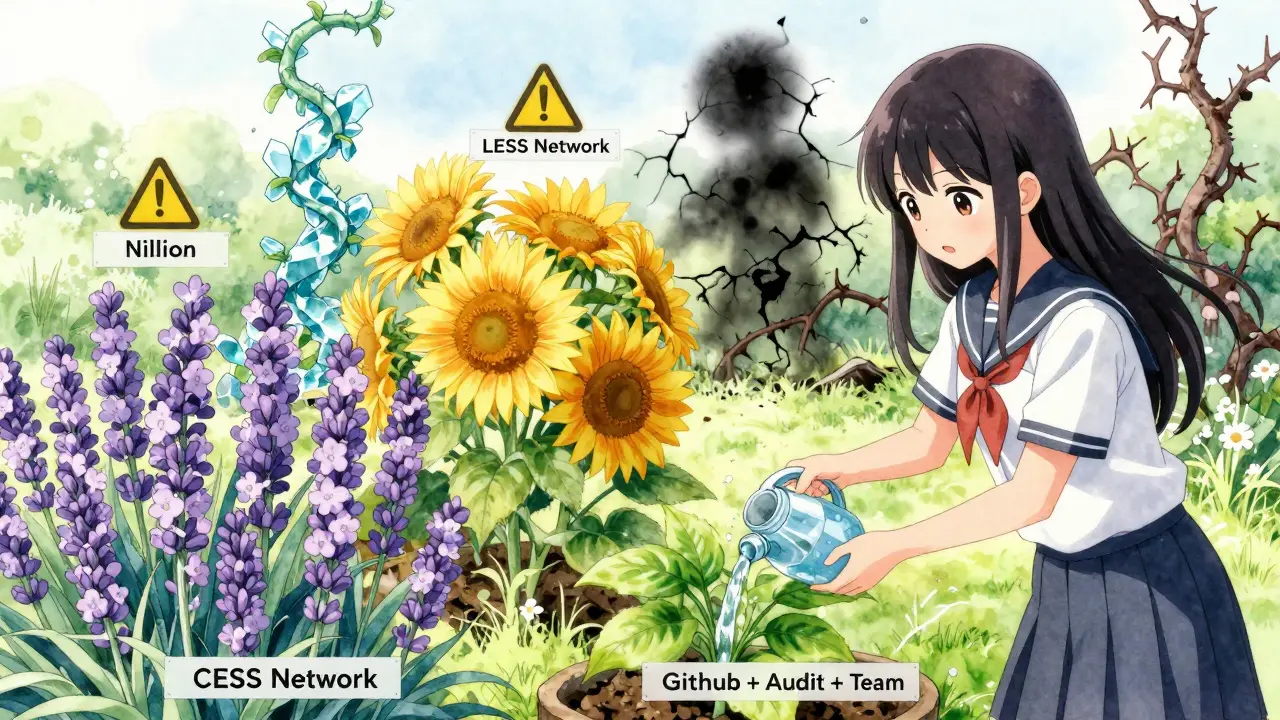
Compare that to real airdrops like CESS Network’s 2025 campaign, which had clear start and end dates, a public wallet address for participation, and a detailed guide on how to qualify. Or Bless Network, which published its eligibility rules and reward distribution schedule months in advance. LESS Network has none of that. No transparency. No trail.
What You Might Be Confusing It With
It’s likely you’re mixing up the name with another project. Many new blockchain networks use similar-sounding acronyms:
- CESS Network - Ran a major airdrop in mid-2025 with 1.3 million CESS tokens and $70,000 in USDT rewards.
- Bless Network - Opened registration in August 2025 for a token launch later that year.
- Nillion Network - Distributed tokens to early users of its privacy-focused compute platform.
- LessCoin - A meme token on Solana with zero relation to any blockchain infrastructure project.
Search engines sometimes auto-correct "LESS" to "Less" or suggest similar names. That’s how fake airdrop pages end up ranking. Don’t trust a site that doesn’t link to a verified team, a real roadmap, or a published audit.
How to Spot a Fake Crypto Airdrop
Fake airdrops are one of the most common ways scammers steal crypto. Here’s what to look for:
- They ask for your private key - No legitimate airdrop will ever ask for this. Ever.
- They require you to send crypto first - Real airdrops give you free tokens. You don’t pay to get them.
- The website looks cheap or copied - Poor grammar, stock images, broken links? Red flag.
- No social media presence - Check Twitter, Telegram, Discord. Real teams post daily. Fake ones have one or two posts from months ago.
- No blockchain explorer link - If you can’t find the token contract on Etherscan, Solana Explorer, or another chain’s explorer, it’s not real.
In 2025, over $230 million was lost to fake airdrop scams, according to Chainalysis. Most victims thought they were signing up for something real - until their wallet was drained.
What to Do Instead
If you’re looking for real airdrops in early 2026, focus on projects with:
- Active development on GitHub
- Public team members with LinkedIn profiles
- Clear tokenomics documented in a whitepaper
- Audits from reputable firms like CertiK or PeckShield
- Official announcements on their website and verified social accounts
Follow trusted sources like CoinDesk, The Block, or official project blogs. Join their Telegram or Discord channels - but never click links sent by strangers. Always type the URL yourself.

Will LESS Network Ever Launch an Airdrop?
Maybe. But not today. And not unless someone builds a real project around the name. Right now, LESS Network is just a name on a scam site. No team. No code. No future.
If you hear about a LESS Network airdrop in the next 30 days, treat it like a phishing email. Don’t click. Don’t connect your wallet. Don’t send any funds. Walk away.
Real crypto innovation doesn’t hide behind fake airdrop pages. It’s open, transparent, and verifiable. If you can’t find proof, it doesn’t exist.
Staying Safe in 2026
The crypto space is full of noise. Airdrops are exciting - but they’re also dangerous if you’re not careful. Your best defense is skepticism and verification.
Before you even think about joining any airdrop:
- Search the project name + "scam" or "review".
- Check if the token has a contract address on a blockchain explorer.
- Look for team members with real profiles, not just avatars.
- Read the terms - if they’re missing or vague, it’s a warning sign.
- Wait for official announcements. Don’t trust influencers pushing "exclusive" links.
There will be dozens of legitimate airdrops in 2026. You don’t need to chase every name that sounds promising. Stick to the ones you can prove are real.
Surendra Chopde
Just saw a Discord server pushing "LESS Network airdrop" with a link to a .xyz domain. I checked the contract address - no such token exists on Ethereum or Solana. This is textbook phishing. Save yourself the headache.
Allen Dometita
Bro if you’re clicking random airdrop links you’re already one step away from losing your whole wallet. Just stick to CoinGecko and official project pages. No exceptions.
Sherry Giles
They’re using this to distract us from the real airdrops the Fed is suppressing. You think they want ordinary people to get free crypto? Nah. This is all part of the plan to keep us poor and distracted. The same people who killed CESS’s momentum are now pushing fake LESS pages. Wake up.
Calen Adams
LESS Network is a ghost project - zero on-chain activity, no dev commits in 18 months, and zero liquidity pools. The fact that people still fall for this is wild. If you’re not checking Etherscan before you connect your wallet, you’re not ready for crypto.
Katrina Recto
I lost $800 to a fake airdrop last year. Never again. Always verify. Always double check. Always assume it’s a scam until proven otherwise.
Veronica Mead
It is deeply concerning that individuals continue to engage with unverified digital assets without exercising the most rudimentary due diligence. The absence of a whitepaper, a verifiable team, or a blockchain explorer listing constitutes a material failure of transparency. Such conduct not only endangers personal financial security but also undermines the integrity of legitimate innovation within the decentralized finance ecosystem. One must ask: how many more must be defrauded before collective vigilance becomes the norm rather than the exception?
Tre Smith
Let’s be real - if you’re reading this and still thinking about joining a "LESS Network" airdrop, you’re not just naive, you’re actively enabling fraud. You think scammers don’t track engagement? They do. They know exactly who clicks. Your wallet isn’t safe just because you didn’t send ETH - you already gave them your IP, your browser fingerprint, your device ID. That’s data they’ll sell to phishing kits. You’re not a victim. You’re a target. And you’re making it easy.
Jordan Leon
There’s a quiet irony here. People chase free tokens like they’re lottery tickets, but refuse to spend five minutes verifying if the project exists. We’ve built entire economies on trustless systems, yet we still hand over our keys to anonymous websites. Maybe the real problem isn’t the scammers - it’s our willingness to believe in something that refuses to show its face.
Danyelle Ostrye
It’s sad how fast people forget what crypto was supposed to be about - openness, transparency, community. Instead we get these ghost projects and hype-driven scams. I’ve seen too many good projects die because of noise like this. Let’s not make it harder for the real ones.
Jessie X
Just checked CoinGecko again. Still no LESS. Zero listings. Zero volume. Zero team. Zero hope. If it’s not on CoinGecko or CoinMarketCap it’s not real. Period
Kip Metcalf
Stay sharp out there folks. The next big airdrop is coming - just not from some sketchy Discord bot. Keep your eyes on the real builders. They’re quiet, they’re coding, and they don’t need to shout to get your attention.
sathish kumar
It is imperative to emphasize that the absence of verifiable documentation, including a whitepaper, a publicly accessible GitHub repository, and audited smart contracts, renders any purported airdrop fundamentally illegitimate. The proliferation of such deceptive schemes reflects a systemic failure in user education within the cryptocurrency domain. One must adhere to the highest standards of verification, for in the absence of transparency, there can be no trust. The integrity of the decentralized ecosystem depends upon the diligence of its participants.
Valencia Adell
Everyone’s so quick to call this a scam. But what if it’s worse? What if LESS Network is a honeypot built by a government-backed group to track crypto users? I’ve seen the pattern - fake airdrops, then sudden wallet freezes, then KYC demands. They’re not stealing your coins. They’re collecting your identity. And you’re handing it to them on a silver platter.