

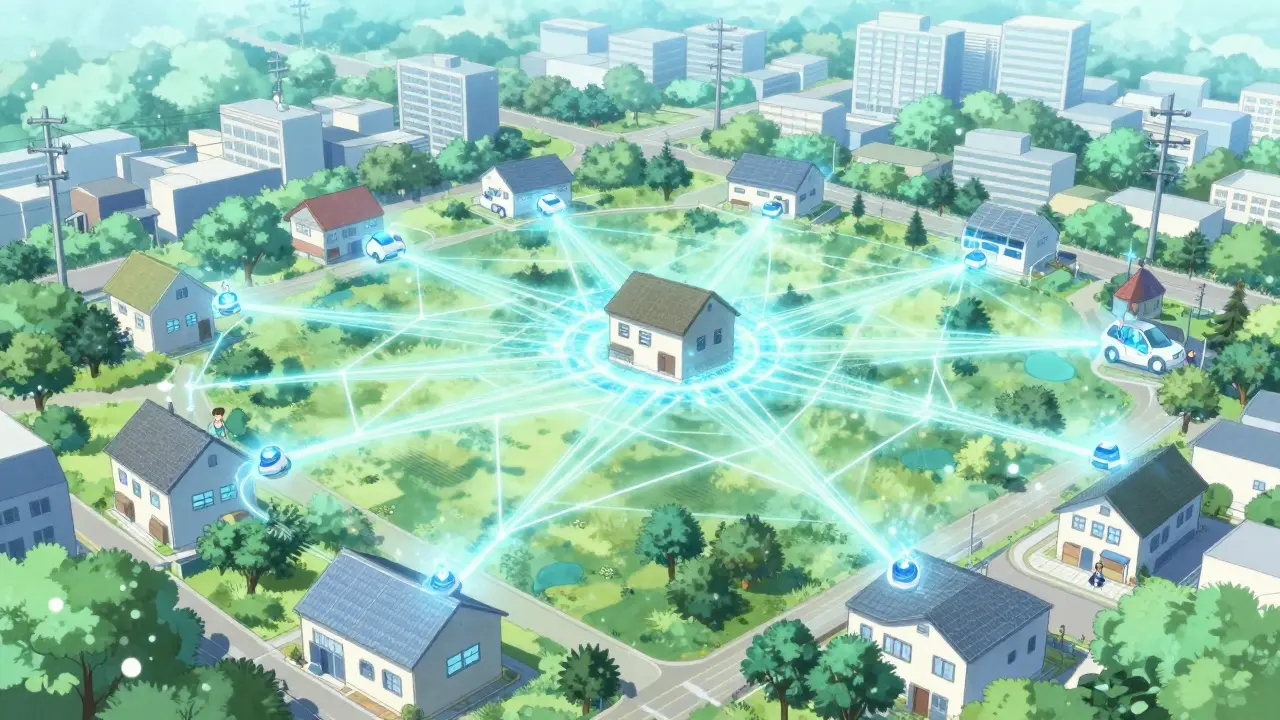
Imagine selling the excess solar power from your rooftop directly to your neighbor instead of feeding it back into a grid that pays you pennies. In 2026, this isn't just a futuristic dream; it's happening right now through energy blockchain platforms. These systems are rewriting the rules of how we buy, sell, and manage electricity by removing the middlemen who have controlled the grid for over a century.
The traditional energy model is centralized, slow, and often opaque. You generate power, you send it to the utility company, and they decide what to do with it. Blockchain technology flips this script. It creates a decentralized ledger where every kilowatt-hour (kWh) generated can be tracked, verified, and traded instantly between peers. This shift empowers local communities, lowers costs, and accelerates the transition to renewable energy sources.
How Energy Blockchain Actually Works
To understand why these platforms matter, you need to look at the mechanics behind the scenes. At its core, an energy blockchain acts as a trusted record-keeper. When you have a smart meter connected to a solar panel system, that meter records exactly how much energy you produce. In a traditional setup, this data goes to the utility provider. In a blockchain setup, that data is hashed and recorded on a distributed ledger.
Here is the simple flow:
- Generation: Your solar panels produce 5 kWh more than you use today.
- Tokenization: The platform converts those 5 kWh into digital tokens representing real energy value.
- Smart Contract Execution: A pre-programmed agreement triggers automatically. If your neighbor needs power, the contract matches your surplus with their demand.
- Settlement: Payment is transferred instantly via cryptocurrency or stablecoin, and the energy token is burned or transferred to reflect consumption.
This process eliminates the need for manual billing, reduces administrative overhead, and ensures transparency. No one can fake the numbers because the ledger is immutable. Everyone sees the same truth about who produced what and when.
LO3 Energy and the Exergy Platform
When talking about specialized energy blockchains, one name dominates the conversation: LO3 Energy. Founded in New York, LO3 Energy is not just another crypto startup; it is an infrastructure company building the backbone for decentralized energy markets. Their flagship product, Exergy, is the engine that makes peer-to-peer (P2P) energy trading possible at scale.
Exergy doesn't rely on a single public blockchain like Ethereum alone. Instead, it uses a modular approach. It integrates with various underlying blockchains but adds a layer specifically designed for energy constraints. Why does this matter? Because energy grids operate in real-time. You cannot wait ten minutes for a transaction to confirm if the grid frequency is dropping. Exergy solves this with sophisticated scalability solutions.
| Feature | Function | Benefit |
|---|---|---|
| AI Transaction Batching | Combines multiple microtransactions from smart meters into single on-chain events. | Reduces network congestion and lowers gas fees significantly. |
| Predictive Load Balancing | Uses algorithms to allocate network resources to high-demand regions instantly. | Ensures unbroken scalability during peak usage times. |
| Dynamic Tokenization | Issues energy units as lightweight digital assets. | Minimizes on-chain complexity while maintaining verifiable ownership. |
| Microgrid Sub-networks | Creates localized sub-networks for specific regional energy systems. | Optimizes processing speed for local community trading. |
The "single-click" trading experience Exergy offers hides immense technical complexity. Behind the scenes, AI batching groups thousands of small transactions-like a household using a toaster or charging an EV-into larger blocks before writing them to the main chain. This keeps costs down and speeds up, making it viable for everyday consumers, not just industrial players.

Choosing the Right Underlying Blockchain
While LO3 Energy provides the application layer, many projects build directly on general-purpose blockchains. Choosing the right base layer is critical for energy projects due to specific needs for speed, cost, and sustainability. Here is how the major players stack up in 2026.
Ethereum: The Established Standard
Ethereum remains the dominant force in smart contracts. With a rating of 4.5/5 for ecosystem maturity, it offers the most robust developer tools and security guarantees. Since its transition to Proof-of-Stake (PoS), Ethereum has reduced its energy consumption by over 99%, addressing the primary criticism against blockchain in the green energy sector. However, during peak network activity, gas fees can still spike, making high-frequency microtransactions expensive unless Layer-2 solutions are used.
Solana: Speed for Real-Time Trading
If speed is your priority, Solana is hard to beat. Rated 4.6/5 for performance, Solana can handle thousands of transactions per second (TPS). For energy trading, where milliseconds matter for grid stability, this throughput is essential. Solana’s low transaction costs make it ideal for frequent, small-value trades. The trade-off? While improving, its network has faced stability challenges in the past compared to Ethereum’s battle-tested uptime.
Binance Smart Chain (BSC): Cost Efficiency
BSC scores 4.4/5 overall, primarily due to its incredibly low transaction fees and fast finality. For energy startups bootstrapping on a budget, BSC offers a compelling alternative. It allows for rapid deployment of dApps without the high development costs associated with Ethereum. It is particularly suitable for pilot programs testing P2P energy models in developing regions where cost sensitivity is high.
Cardano: Sustainability First
Cardano, rated 4.3/5, was built with academic rigor and a focus on sustainability. Its Ouroboros Proof-of-Stake consensus mechanism is highly energy-efficient. For projects prioritizing environmental credentials and long-term governance stability, Cardano is a strong contender. Its ecosystem is smaller than Ethereum’s, but it attracts developers who value formal verification methods to prevent bugs in critical infrastructure code.
Polkadot: Interoperability Hub
With a 4.5/5 rating, Polkadot shines in cross-chain communication. Energy systems rarely exist in isolation; they connect to water management, carbon credit markets, and financial services. Polkadot’s parachain architecture allows different blockchain networks to communicate seamlessly. If your energy project needs to interact with multiple external systems, Polkadot provides the necessary bridges.
| Platform | Consensus | Key Strength | Best Use Case | Rating |
|---|---|---|---|---|
| Ethereum | Proof-of-Stake | Largest Ecosystem & Security | Large-scale enterprise deployments | 4.5/5 |
| Solana | PoS (Proof of History) | High Throughput & Low Latency | Real-time grid balancing & IoT | 4.6/5 |
| Binance Smart Chain | Proof of Staked Authority | Lowest Transaction Costs | Cost-sensitive pilot projects | 4.4/5 |
| Cardano | Ouroboros PoS | Energy Efficiency & Formal Verification | Sustainability-focused initiatives | 4.3/5 |
| Polkadot | Nominated PoS | Cross-Chain Interoperability | Multi-system integration | 4.5/5 |
Implementation Challenges and Solutions
Building an energy blockchain platform is not just about coding smart contracts. It involves navigating complex regulatory landscapes, integrating with legacy grid infrastructure, and ensuring user adoption. The learning curve is steep. Developers must understand distributed ledger fundamentals, tokenomics, and energy market regulations simultaneously.
A typical full deployment takes 6 to 12 months. This timeline includes:
- Regulatory Compliance: Ensuring the platform meets local energy trading laws. In Europe and North America, regulations are evolving to support P2P trading, but nuances vary by state and country.
- Hardware Integration: Connecting to smart meters and IoT devices. This requires robust APIs and secure data transmission protocols.
- User Experience Design: Hiding the blockchain complexity. Users should see a simple app interface, not wallet addresses and gas fees. LO3 Energy’s success lies in this abstraction layer.
- Security Audits: Critical infrastructure demands zero vulnerabilities. Smart contracts must undergo rigorous third-party audits to prevent exploits.
One major pitfall is ignoring scalability from day one. Early projects often fail because they didn’t account for the volume of microtransactions generated by residential solar panels. Using Layer-2 scaling solutions or off-chain processing, as LO3 Energy does, is no longer optional-it’s a requirement for viability.
The Future of Decentralized Energy Markets
We are standing at the edge of a new energy era. The convergence of blockchain, artificial intelligence, and IoT is creating a grid that is self-healing, efficient, and democratic. As more homeowners install solar panels and electric vehicles become commonplace, the strain on traditional grids will increase. Blockchain platforms offer a way to distribute this load intelligently.
Look out for increased integration with carbon credit markets. Soon, selling your excess solar power might also earn you carbon offsets automatically, verified on-chain. We will also see more corporate procurement deals where businesses buy green energy directly from community microgrids via blockchain contracts, bypassing traditional utilities entirely.
The technology is ready. The platforms like Exergy are proven. The question is no longer if decentralized energy trading will happen, but how quickly your neighborhood will join the grid of the future.
What is the best blockchain for energy trading?
There is no single "best" blockchain, as it depends on your specific needs. For high-speed, real-time transactions, Solana is currently the top choice due to its high throughput. For established ecosystems and security, Ethereum remains the standard, especially with its eco-friendly Proof-of-Stake consensus. For specialized applications, platforms like LO3 Energy's Exergy provide optimized layers on top of these chains to handle energy-specific requirements efficiently.
How does LO3 Energy make money?
LO3 Energy operates as a B2B infrastructure provider. They license their Exergy platform to utilities, municipalities, and energy companies looking to launch peer-to-peer trading programs. They may take a small fee per transaction or charge licensing fees for the software infrastructure, rather than profiting directly from the energy trades themselves.
Is blockchain energy trading legal?
Legality varies by jurisdiction. Many regions in Europe, Australia, and parts of the United States have introduced regulations allowing limited peer-to-peer energy trading. However, large-scale commercial trading often faces stricter scrutiny regarding licensing and grid access. Always consult local energy regulators before launching a public trading platform.
Can I use my home solar panels with these platforms?
Yes, but you typically need to be part of a participating community or microgrid program. You will need a compatible smart meter and an internet connection. The platform handles the tokenization and trading in the background, so you don't need to be a tech expert. Look for local utility pilots or community solar projects adopting Exergy or similar technologies.
Why is scalability important for energy blockchains?
Energy usage happens in tiny increments throughout the day. Millions of households generating and consuming power create millions of microtransactions. If a blockchain cannot handle this volume quickly and cheaply, the network will clog, fees will skyrocket, and the system becomes unusable. Scalability solutions like sharding, Layer-2s, and transaction batching are essential to keep the grid running smoothly.