

Imagine you are a filmmaker with raw footage that cannot be lost. You do not trust a single cloud provider because one server failure or a subpoena could wipe your project off the face of the earth. This is where Decentralized Storage is a system that distributes encrypted data fragments across multiple independent nodes on a distributed network rather than relying on a single centralized server. It changes how we keep files safe by spreading them out so no one company holds all the keys.
This technology has moved from theory to reality. Since its pioneering days between 2013 and 2015, projects like IPFS, Storj, and Siacoin have built the foundations. Today, platforms like Filecoin and Sia handle thousands of terabytes of data. If you are curious about how this works or if it is right for your business, here is what you need to know.
How Decentralized Storage Works Under the Hood
At its core, decentralized storage is about breaking things down. When you upload a file, the system does not just copy it to a backup drive. Instead, it shreds the file into smaller pieces called shards. These shards are then encrypted on your device before they leave your computer. The private encryption key stays with you, meaning the network providers never see the actual content, just scrambled data.
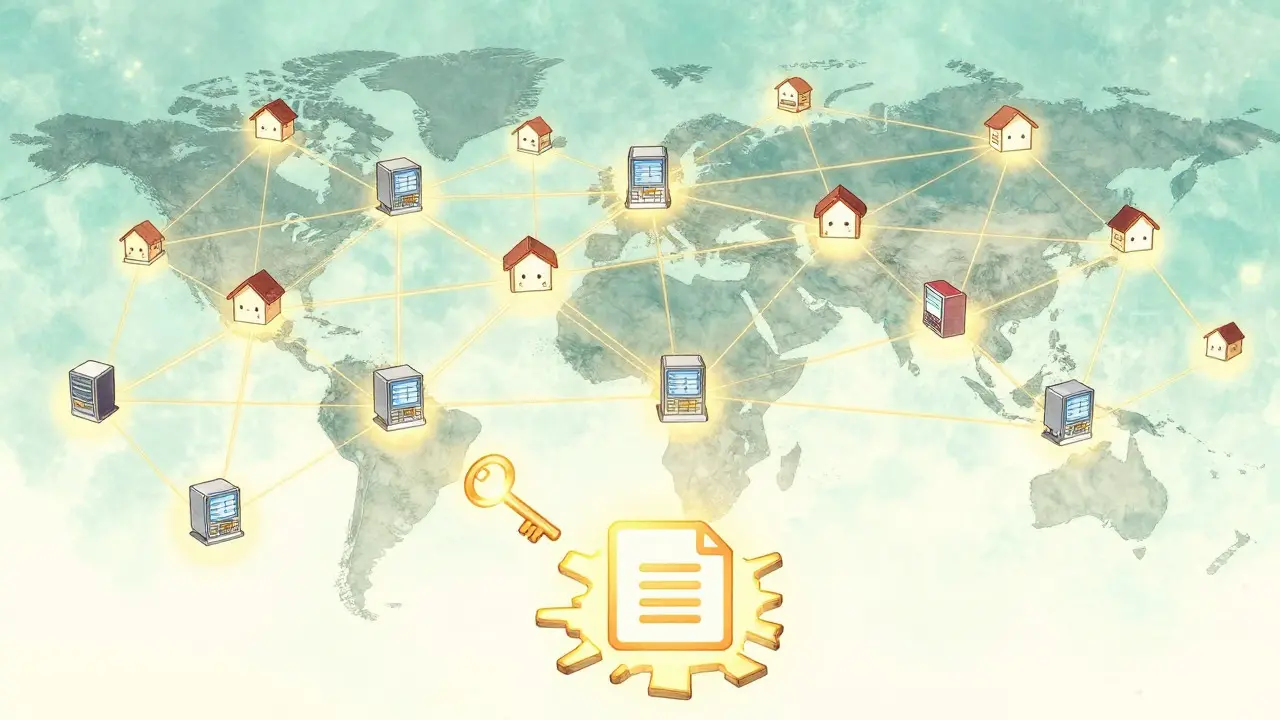
Once encrypted, these shards are sent to various nodes around the world. A node is simply a computer operated by an independent user who has rented out their unused hard drive space. Because the file is split up and scattered, no single node can read the complete file. To get your data back, the network pulls the necessary pieces from different locations and reassembles them. But again, only you can unlock them with your key.
- Fragmentation: Files are broken into small shards.
- Encryption: Data is secured client-side before upload.
- Distribution: Shards are spread across geographically diverse nodes.
- Retrieval: Pieces are gathered and reassembled using the user's key.
The Role of Blockchain in Data Integrity
You might wonder why we need blockchain for storing files. After all, file systems have existed for decades. The answer lies in trust and verification. In traditional cloud storage, you have to trust the provider to tell you if your file is still there and unchanged. In decentralized networks, Blockchain acts as the public ledger that tracks where every shard is located.
When a file is stored, the blockchain generates a cryptographic hash-a unique digital fingerprint of that data. If even one byte of the file changes, the hash no longer matches. This instantly alerts users to tampering. For example, a law firm archiving contracts on a blockchain-backed network can be certain that no one has altered a clause, because any change would break the hash match. This creates a level of transparency and immutability that centralized servers rarely offer.
Major Platforms and Their Approaches
Not all decentralized storage networks are built the same way. Some run on their own blockchains, while others piggyback on established ones. Here is how some of the leading players operate:
| Platform | Core Mechanism | Incentive Token | Key Feature |
|---|---|---|---|
| Filecoin | Marketplace for storage miners | FIL | Built on IPFS; open-source marketplace |
| Sia | Connects users with hosts | Siacoin (SC) | Skynet for content delivery; 1M+ downloads |
| IPFS | Peer-to-peer hypermedia protocol | N/A (Protocol) | Content-addressed storage; foundational tech |
Filecoin launched its live service in October 2020 and operates as a marketplace. Users bid for storage, and providers earn rewards for keeping data available. Sia takes a similar approach but also offers Skynet, a platform for developers to build decentralized applications. Both rely on economic incentives to keep the network running.
Security, Privacy, and Censorship Resistance
Why go through all this trouble? The main benefit is resilience. In a centralized system, if the server goes down, your data is inaccessible. If the company gets hacked, your data is exposed. In a decentralized network, you would have to take down a significant portion of the global node network to lose access to your files.
This architecture also makes censorship difficult. Since no single entity controls the network, it is much harder for governments or corporations to force the deletion of specific files. For individuals who value privacy, this is a game-changer. Your data belongs to you, not the host. The redundancy means that even if some nodes fail or go offline, your data remains retrievable from the remaining healthy nodes.
Economic Incentives: Earning While You Store
One of the most attractive aspects of decentralized storage is the potential for passive income. If you have unused hard drive space on your computer, you can rent it out to the network. In return, you earn cryptocurrency tokens, such as FIL or SC. This creates a self-sustaining ecosystem where data availability is rewarded financially.
For instance, a freelance developer might lease 500 gigabytes of space on Filecoin and earn tokens over time. This turns idle hardware into productive infrastructure. For the network, this ensures there is always enough capacity to store new data without needing massive, expensive data centers owned by a single corporation.

Practical Use Cases Beyond Backups
While personal backups are a common use case, decentralized storage shines in professional scenarios. Filmmakers use it to distribute raw footage securely, knowing that the blockchain ledger will track the location of every piece even if some nodes drop out. Legal teams use it for contract archiving, ensuring documents remain tamper-proof. Researchers share large datasets without worrying about a single point of failure.
These examples show that decentralized storage is not just a tech trend; it is a practical solution for industries that require high reliability and low trust in third parties. It shifts control from the infrastructure operator back to the data owner.
Decentralized vs. Centralized: The Key Differences
To make an informed decision, it helps to compare the two models directly. Centralized storage is convenient and fast for everyday use, but it comes with risks. You are dependent on the provider’s uptime, pricing, and legal jurisdiction. Decentralized storage offers more control and resilience, but it may require more technical understanding to set up and manage.
- Control: Centralized gives control to the provider; Decentralized gives it to the user.
- Resilience: Centralized has single points of failure; Decentralized has redundant paths.
- Cost: Centralized often has subscription fees; Decentralized costs are based on market rates for storage.
- Privacy: Centralized providers can see metadata; Decentralized providers see only encrypted shards.
If you prioritize absolute sovereignty and long-term preservation, decentralized storage is the stronger choice. If you need quick, easy access for casual use, centralized cloud services might still be sufficient. Many savvy users adopt a hybrid approach, using both for different types of data.
Frequently Asked Questions
Is decentralized storage faster than cloud storage?
It depends on the network load and number of nodes. Because data is pulled from multiple sources simultaneously, download speeds can be very high, often exceeding centralized limits. However, initial setup and retrieval times can vary based on network conditions.
Do I need to understand coding to use decentralized storage?
Not necessarily. Most major platforms like Filecoin and Sia offer user-friendly interfaces or desktop apps. However, understanding the basics of wallets and token management is helpful. Developers have more complex options for building custom applications.
What happens if a node goes offline?
Nothing bad happens to your data immediately. The system is designed with redundancy, meaning multiple copies of each shard exist on different nodes. If one goes offline, the network retrieves the data from another node holding the same fragment.
How much does it cost to store data?
Costs are determined by market supply and demand for storage space. Generally, it is cheaper than traditional enterprise cloud solutions but requires payment in cryptocurrency. Prices fluctuate based on the price of the native token and network usage.
Can I delete my data from the network?
Yes, but it works differently than deleting a file from a hard drive. You stop paying for the storage contract. Once the contract expires, the nodes are free to reuse that space. The data becomes unretrievable without your key, effectively disappearing from active circulation.