

Trading on Ethereum mainnet can feel like paying rent in a city you don't live in. The gas fees are steep, the confirmation times vary, and sometimes you just want to swap tokens without checking your bank account first. This is where Layer 2 solutions come into play, and Arbitrum has become the heavyweight champion of this space. But once you are on Arbitrum, which decentralized exchange should you trust with your assets? If you are looking at Fraxswap, a key component of the Frax Finance ecosystem designed for token swaps, you are asking the right questions. This review breaks down what Fraxswap offers on Arbitrum in 2026, focusing on fees, liquidity, security, and how it stacks up against the competition.
The Core Identity of Fraxswap
To understand Fraxswap, you have to look at its parent protocol, Frax Finance. Founded by Sam Kazemian, Frax launched in December 2020 with a unique stablecoin called FRAX. Unlike fully fiat-backed stablecoins or purely algorithmic ones, FRAX uses a fractional-algorithmic model. It stays pegged to $1 through a mix of collateral (like USDC) and algorithmic mechanisms. Fraxswap is the decentralized exchange arm of this ecosystem. Its primary job is to facilitate trades for FRAX, FXS (the governance token), and other major assets.
When Fraxswap expanded to Arbitrum in late 2022, it aimed to leverage the network's speed and low costs while maintaining Ethereum's security guarantees. In 2026, this integration is mature. You aren't just swapping tokens; you are interacting with a protocol deeply integrated into the broader DeFi landscape. Fraxswap supports concentrated liquidity, similar to Uniswap V3, which allows liquidity providers to deploy capital more efficiently within specific price ranges. For traders, this often means tighter spreads and less slippage on popular pairs.
Fees and Cost Efficiency on Arbitrum
Cost is king in DeFi. On Ethereum mainnet, a simple swap can cost anywhere from $5 to $50 depending on network congestion. On Arbitrum, that number drops significantly. Typical gas fees on Arbitrum are 90-95% lower than on Ethereum mainnet. Transaction finality happens in 2-5 seconds, compared to the 13-15 seconds you might wait on L1.
But gas isn't the only fee. Trading fees matter too. Most Automated Market Makers (AMMs) on Arbitrum charge between 0.25% and 0.30% per trade. Fraxswap generally aligns with this standard. However, there is a twist. If you hold FXS tokens, you may be eligible for fee discounts. This is a common strategy in DeFi protocols: reward loyalty and governance participation. Before you start trading, check the current fee structure on the Fraxswap interface. While some promotional periods offer 0% fees for certain pairs, these are temporary. For consistent trading, expect the standard AMM rate, but factor in potential savings if you stake FXS.
| DEX Platform | Average Trading Fee | Gas Fee Estimate (Arbitrum) | Liquidity Provider Incentives |
|---|---|---|---|
| Fraxswap | 0.25% - 0.30% | $0.01 - $0.10 | FXS staking discounts |
| Uniswap V3 | 0.05% - 1.00% | $0.01 - $0.15 | None directly |
| SushiSwap | 0.30% | $0.01 - $0.12 | Sushi token rewards |
| Camelot | 0.01% - 0.30% | $0.01 - $0.10 | GRAIL token incentives |
Liquidity Depth and Token Availability
A DEX is only as good as its liquidity. Low liquidity means high slippage, which eats into your profits. Fraxswap shines when trading assets related to its own ecosystem. Pairs involving FRAX, FXS, and fUSDT typically have deep pools. This makes sense: the protocol prioritizes its own tokens to ensure stability and usability.
For major pairs like ETH/USDC or WBTC/USDT, Fraxswap is competitive but not always the deepest. Uniswap and Camelot often lead in total volume for these blue-chip pairs. If you are moving large amounts of capital, you might need to split your order across multiple DEXs or use an aggregator like 1inch or OpenOcean. These tools scan Fraxswap, Uniswap, SushiSwap, and others to find the best price. In 2026, using an aggregator is almost mandatory for serious traders who want to minimize slippage.
One advantage of Fraxswap is its focus on stablecoins. With the rise of algorithmic and fractional models, having a dedicated pool for FRAX and other stable assets provides a safe haven during volatile markets. If you are rebalancing a portfolio heavy on stablecoins, Fraxswap offers efficient routes with minimal price impact.

Security and Trust Factors
Security is non-negotiable in crypto. Fraxswap operates as a non-custodial protocol. This means you never hand over your private keys. Your assets stay in your wallet until you execute a swap. This reduces the risk of exchange hacks, which have plagued centralized platforms like FTX and Mt. Gox.
However, smart contract risk remains. Every interaction with Fraxswap involves executing code on the blockchain. Has Fraxswap been audited? Yes. The Frax Finance ecosystem undergoes regular audits by reputable firms. These audits check for vulnerabilities like reentrancy attacks, overflow errors, and logic flaws. While no system is immune to bugs, the fact that Fraxswap has operated since 2022 without major incidents speaks to its robustness.
It is also worth noting that Arbitrum itself adds a layer of security. As an Optimistic Rollup, it inherits Ethereum's security model. Any fraudulent transaction can be challenged during a dispute window. This makes Arbitrum one of the safest Layer 2 networks available. When combined with Fraxswap's audited contracts, you get a relatively secure environment for trading.
Regulatory status is another point to consider. Like most DEXs on Arbitrum, Fraxswap is not regulated by any government authority. It operates globally, accessible to anyone with a web browser and a wallet. This lack of regulation means no KYC (Know Your Customer) requirements, preserving your privacy. But it also means no recourse if something goes wrong. You are responsible for your own security. Always double-check URLs, verify contract addresses, and use hardware wallets for significant holdings.
User Experience and Interface Design
DeFi interfaces used to be clunky and confusing. Today, they are much more user-friendly. Fraxswap's UI is clean and intuitive. You connect your wallet (MetaMask, WalletConnect, etc.), select the tokens you want to swap, and enter the amount. The interface shows you the expected output, price impact, and minimum received before you confirm.
One feature that stands out is the integration with the broader Frax ecosystem. You can easily move between swapping, providing liquidity, and staking FXS without leaving the platform. This seamless experience reduces friction and encourages deeper engagement. For beginners, however, there is still a learning curve. Concepts like slippage tolerance, gas limits, and liquidity pools are not explained in detail within the interface. You need a basic understanding of DeFi mechanics to use Fraxswap effectively.
Mobile support is also solid. The website is responsive, and many users prefer trading on their phones. Just ensure your mobile wallet is set up correctly and you have enough ARB in your wallet to pay for gas fees. Running out of ARB mid-transaction is a common mistake that leaves funds stuck in pending states.
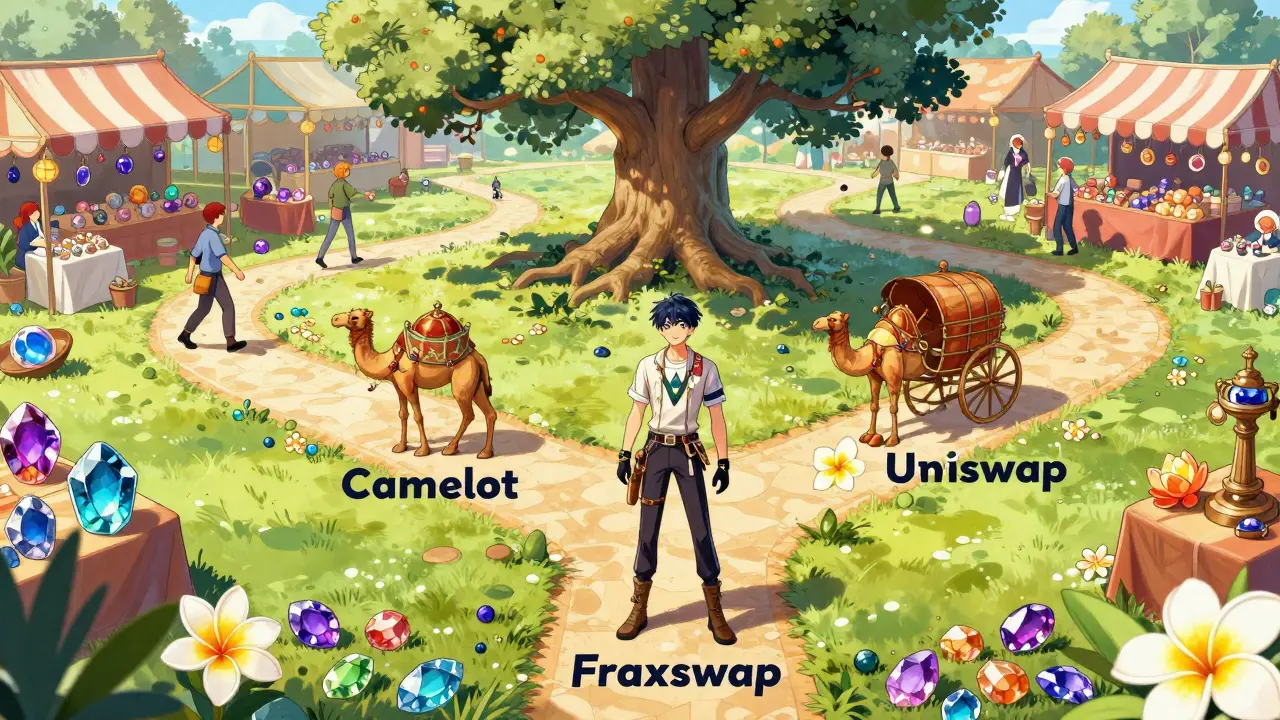
How Fraxswap Compares to Competitors
The Arbitrum DEX landscape is crowded. Who else should you consider?
- Uniswap: The giant. Uniswap has the deepest liquidity for most pairs. If you are trading obscure tokens, Uniswap might be your only option. However, it lacks the ecosystem-specific optimizations that Fraxswap offers.
- Camelot: Built specifically for Arbitrum, Camelot has gained traction with its low fees and native GRAIL token incentives. It is a strong competitor for general-purpose trading.
- SushiSwap: A veteran in the space, SushiSwap offers a wide range of features including lending and yield farming. Its liquidity is decent, but it trails behind Uniswap and Camelot on Arbitrum.
- OpenOcean: Not a DEX itself, but an aggregator. OpenOcean routes trades through multiple DEXs, including Fraxswap. If you want the best price without manually checking each platform, use OpenOcean.
Fraxswap holds its ground by focusing on quality over quantity. It may not have the highest volume for every token, but for FRAX-related trades, it is hard to beat. The combination of deep liquidity, low fees, and ecosystem integration makes it a top choice for users invested in the Frax universe.
Who Should Use Fraxswap on Arbitrum?
Fraxswap is ideal for several types of users:
- Frax Ecosystem Participants: If you hold FXS or use FRAX, Fraxswap is your home base. The liquidity is deepest here, and the fees are optimized.
- Stablecoin Traders: Looking to swap between different stablecoins with minimal slippage? Fraxswap's stablecoin pools are efficient and reliable.
- DeFi Savvy Users: Those who understand liquidity provision, impermanent loss, and governance can maximize their returns by engaging with Fraxswap beyond just swapping.
- Privacy-Conscious Traders: No KYC means you can trade anonymously. Just remember that anonymity does not mean invisibility. Blockchain analysis tools can still track your activity.
If you are a beginner just starting out, you might find simpler interfaces like Coinbase or Binance easier to navigate. But if you are ready to dive into DeFi, Fraxswap on Arbitrum is a solid entry point. Start small, learn the ropes, and gradually increase your exposure.
Final Thoughts on Fraxswap in 2026
The crypto market evolves rapidly. What was true in 2024 may not hold in 2026. However, the core principles remain: low fees, high liquidity, and strong security. Fraxswap on Arbitrum delivers on all three fronts. It is not the biggest DEX by volume, but it is a focused, efficient, and trustworthy platform. Whether you are swapping FRAX for ETH or providing liquidity to earn yields, Fraxswap offers a compelling value proposition. As always, do your own research. Read the docs, check the audits, and never invest more than you can afford to lose.
Is Fraxswap safe to use on Arbitrum?
Yes, Fraxswap is considered safe. It operates on Arbitrum, a secure Layer 2 network, and its smart contracts have undergone multiple audits. However, as with any DeFi platform, you should always verify contract addresses and use a hardware wallet for significant amounts.
What are the trading fees on Fraxswap?
Trading fees on Fraxswap typically range from 0.25% to 0.30%. Gas fees on Arbitrum are very low, usually under $0.10 per transaction. Holding FXS tokens may provide additional fee discounts.
Do I need KYC to use Fraxswap?
No, Fraxswap is a decentralized exchange and does not require Know Your Customer (KYC) verification. You can connect your wallet and start trading immediately.
How does Fraxswap compare to Uniswap on Arbitrum?
Uniswap generally has higher overall liquidity for major pairs. Fraxswap excels in liquidity for FRAX and FXS tokens. Both platforms offer similar fee structures and security levels. For the best prices, consider using an aggregator that routes through both.
Can I earn rewards by providing liquidity on Fraxswap?
Yes, liquidity providers on Fraxswap earn trading fees proportional to their share of the pool. Additionally, Frax Finance occasionally offers incentives in FXS tokens for providing liquidity to specific pools.